Posted by: 1000fish | July 23, 2026

Let’s Go Down to Mexico

DATELINE: JUNE 1, 2025 – PUERTO PENASCO, MEXICO

This will be a road trip blog. The standard by which road trips are measured is the 2014 “Band of Brothers” Road Trip, and while I was thinking through comparisons between the two, the first thing that struck me was that somehow, when I wasn’t paying attention, eleven years had passed since that two-week exhibition of poor dietary choices. (And who could forget that curiously-timed case of bird flu?) My big takeaway from that journey was how special it was to just be “one of the guys” instead of a father or weird uncle figure, making me treasure my own youth all the more.

The theme song of that trip was Blake Shelton’s “Playboys of the Western World,” and one of the key lyrics is “Let’s go down to Mexico.” And so it was, 11 years later, that another generation of species hunters, two college-age buddies, wanted to do a road trip to Puerto Penasco, and me, having been there before and being old enough to rent a car, got invited along. I could hear that song again in my head, but could only pray that no one would end up naked or arrested. And could I possibly be accepted as “one of the guys,” or was it time to take the role of cantankerous grandfather?

Our cast of characters is a familiar one. You know Vince from a number of blogs, most recently in the deacon rockfish episode. Jacob, another intense life lister from Ventura, California, had set me up with species such as the shadow goby and the California pompano. Both of them were now adults, or at least college students, which in my case was like being an adult except with more bad decisions. (Not that I have evidence these two have made any notable bad decisions – they’re both pretty responsible.) They had not been to Penasco, so it was a wide open shooting gallery of new species for them. I have been to Penasco at least half a dozen times, but the Cortez stingray had still eluded me. It was time to fix that.

We all met up down in Phoenix, where I went through the horror of renting a car for Mexico. There’s a lot of paperwork and cost involved, but it beats Mexican jail if you have even a fender-bender.

Norena at Hertz Phoenix, who kept us out of jail. That’s Vince on the left and Jacob next to me.

The drive down was, frankly, a bit odd. Even though I have been going to Rocky Point for 11 years, I realized that I had never done the driving, and I found myself asking a question I should probably ask myself a lot more – “What would Chris Moore do?” For Chris had taught me to never, ever exceed the ridiculous 12 mile an hour speed limit in Sonoyta. After that, it was pretty easy, and we were at our condo and setting up tackle.

(A big shout out to Dave, the owner of the fabled Capone’s restaurant and brewery, the finest food in Northern Mexico, and, frankly, Southern Arizona. He rented us the condo and made sure we were brilliantly fed each night.)

From left to right, that’s Steve, Dave, Jacon, and Vince.

On that first day, we raced down to the harbor and jumped on board with El Jefe, one of my favorite charter operators in the area.

El Jefe, the guy you need to take for any short-to-medium range trips in the area. He knows where the fish are.

This is a guy who truly feels the needs of the species-hunting world, and it was a blast to watch the kids nail all the stuff that I got the first time I visited Rocky Point.

The lance lizardfish were out in force.

I thought the guys both had records, but it turns out that someone had found much bigger ones since I had been there last. Such is life – while the competitive part of me doesn’t like having records broken, the (very small) mature part enjoys adding new species to the IGFA rolls and inspiring other anglers to find bigger ones.

The guys enjoy a calm day on the Sea of Cortez – it can get bumpy here in a hurry. Just ask Chris Moore, who threw up his own socks on a particularly breezy day a few years ago.

Day two was a lagoon adventure, and this time, we would have to hoof the sandy mile to the water. (Chris’ buddy with the dune buggies was not in town.)

The lagoon at low tide. Just a few hours later, most of this would be underwater. The tidal shifts here are enormous, reaching 18 feet on some days, so pack light and be prepared to keep moving.

This tidal estuary, just east of the main city, is a hotspot for throwing lures and hosts some truly interesting species, including the dreaded Cortez stingray, which everyone but me has caught. And no, I didn’t this time either, thanks for asking.

I can catch oddly-patterned Haller’s rays all I want, but the more colorful Cortez continues to elude me. Even Spellman has caught one.

While the guys got plenty of everything, I did manage to get my first species of the trip – a Guaymas goby, courtesy of Jacob’s sharp eyes. I had seen them there before and just assumed they were mudsuckers. Shame on me.

The beast. Species number 2397. Could 2400 be in store on this trip?

Vince tacked on several new lifers, including a Cortez Croaker.

Jacob tacked on a guitarfish, which I of course thought was the standard shovelnose we get in California.

The guys stayed up half the night researching our catches, and discovered the guitar was a different species – the spadenose – so I was desperate to go back there and get one. Even though they had access to the car and Penasco is quite a party town, they mostly spent the evenings picking apart anchovies and counting gill rakers.

Our third day was a biggie – we finally had good weather to do a trip with Fish On Charters, a highly-regarded local operator with a large, fast boat, specializing in long runs south to target big groupers. It’s not an inexpensive trip, but it’s a must for the serious species hunter trying to get everything they can out of the region.

Even at 30mph, it’s a solid two hours to the reefs they target. It went by quickly as we checked and re-checked gear and discussed every possible fish we could encounter, beginning with the almost-guaranteed spotted cabrilla, and with ending the rarely-seen parrot bass. We made a quick stop to get some live baits – croakers, grunts, and pretty much anything else in the 1-2 pound range. Groupers are not picky about what they eat.

On my first drop, I brought up something of a conundrum. It was a croaker, a Micropogonius for those of you who care about such things. These creatures are an ID mess, but also some open world records. After some weeks of research, heavily aided by Vince and Jacob, the beast was narrowed down to a Golden Croaker, and it became my 249th world record.

This is just about the right size for grouper food.

As soon as we stopped running and put the baits down, the guys got crushed. Grouper fights are like Cousin Chuck’s first date – trying to wrestle something out of the rocks.

Vince scored first with a nice leopard grouper.

Jacob was not far behind with a solid gulf grouper.

I seem to have a gift for spotted cabrilla.

Everyone took some time to cast spoons and tack on some solid Sierra mackerel.

I decided to drop smaller baits to see what was down there, and there were some astonishing rewards. The first was my personal best stone scorpionfish. These difficult-to-handle bottom dwellers are excellent eating, and this one looked to be fairly good-sized.

Do NOT put this in your pants. (By the way, when we weighed it at the harbor, it turned out to be my 250th world record.) I think I can safely say I have half of Marty Arostegui’s total now. But just barely. I also want to note that Carson Moore caught a bigger one a couple of years ago and didn’t submit it because, as a teenager, shelling out the money for the application was more than he wanted to spend. Dude – as a graduation present, your next one is on me.

Then it got wonderful. I had a solid bite and a nice fight off the bottom, and as the fish came into view, I could not form words, but the crew discerned from my grunts and squeals that I wanted a net. It was a parrot bass, a calico relative that is very occasionally found on deep reefs in the Northern Sea of Cortez, and something I had admired in books for years.

Oh hell yes. Species two of the trip and 2398 lifetime. I would have done the whole trip just for this fish.

Moments later, Jacob landed one.

It would be rude of me to point out that mine was bigger. So I won’t.

Vince was now the only guy on the boat who didn’t have a parrot bass, and yes, he was noticeably agitated. He fished hard, caught a few false-alarm croakers, and then had to sit there while I did something awful.

Yes, I caught another one. A juvenile, which still would have counted for Vince, but alas, he did not end up catching this particular beast and was emotionally devastated.

The gang at FishOn. I highly recommend them for a long-distance bottom trip out of Penasco – they were outstanding. Note that Vince is smiling bravely, but that under that polite veneer is a soul full of parrot bass pain.

Now that’s a load of grouper. We ate like kings at Capone’s. Baked grouper, grouper etouffee, blackened grouper – you name it, they made it for us. Note that Vince can’t quite muster a smile in this one.

Day four was another run with Jefe, to some medium-distance spots where we could expect an assortment of bottom fish, with a chance at more grouper and a shot at some weird bottom critters. My very first fish of the day was a new one – the naked puffer.

Aren’t they all actually naked? And this was now 2399 – the next species would be a milestone, and I was happy it wasn’t something with “naked” in the name.

The guys kept themselves busy casting for sierra mackerel while they waited for grouper bites – and there were plenty of grouper bites. They each got two, a mix of gulf and leopard, and dozens of other bottom fish.

Somewhere in there, I had a soft bite and hooked into a fish that fought strangely – a vibrating, twisting, back-and-forward kind of thing. When we got it on board, I was equal parts thrilled and amused – it was a Pacific snake eel, technically a new species for me but one that had a dark and embarrassing backstory.

I had actually landed one of these on the beach at Buena Vista with my buddy Mike back in 1996, but we thought it was a sea snake and we cut it off and ran like the French army.

Either way, it was species 2400, barely four years after #2000. And no, I’m not agreeing to any goals other than 2401.

I also got a mackerel or five. These things are a killer on light tackle, and will attack anything shiny.

The end of day shot with Jefe – my best trip with him ever.

When we had all said our goodbyes with Jefe, we all noticed a lot of splashing and activity a couple of docks away. On closer inspection, we discovered that there was a large school of anchovies hugging the shoreline, trying to get away from all manner of predators. We saw corvina, bay bass, and leatherjacks slicing through the school, and it didn’t take long to set up a sabiki and a couple of live bait rods. I mostly focused on catching bait for the guys, and they stuck fish after fish on light tackle.

Vince with a leatherjack and Jacob with a corvina. It was a marvelous and unexpected way to close out the day.

It was non-stop for a couple of hours. I’ve never seen the harbor that wide open before – I fired the occasional lure into the mix and got bay bass and corvinas.

A bay bass on the spoon.

We ate at Capone’s again, and Dave’s team wowed us with yet more amazing grouper recipes. We certainly talked a lot of shop over those meals, and a bit of life, but I was definitely the elder statesman of the group. Not that we didn’t share the occasional rude joke, and frankly, theirs were better than mine.

The next day would be our last in Penasco, and we decided to give the lagoon another go. Everyone needed something there, and the tides were perfect.

That same morning, 1500 miles north, something far more important was happening. Marta, well known for supporting worthy causes and taking on nearly-impossible quests, had decided, with not a lot of time to train, to do the AIDS benefit ride – an eight-day, 545-mile bicycle hellathon that featured some 3000 vertical feet of climbing each day. I wouldn’t do that in my car. An amateur cyclist at best, she had convinced herself she could finish the ride, and had raised some thousands of dollars for a very worthy cause.

No, she didn’t do it on a cruiser bike, but “Breaking Away” is one of her favorite movies.

I almost destroyed the day before we got a chance to wet a line. Despite dozens of warnings from Chris, I managed to get our rental stuck in the sand out by the lagoon.

We wasted an hour before a kind-hearted local with a 4×4 dragged us out.

On top of that, it started raining, and none of us had thought to bring so much as a poncho. This was Little Bighorn-style bad planning, because it can get surprisingly cold when it’s windy and raining like hell. Still, we focused on catching small live baits and getting them into the channel, and one by one, the catches started piling up.

My personal best shortfin corvina.

And yes, a spadenose. I actually got two. If I had known this at the time, it would have been an easy world record, dammit. The guys did well also, but we were all shivering until the rain let up after four or five hours.

We celebrated a successful trip with one more trip to Capone’s, and that evening, the texts from Marta started streaming in – “OMFG. It was 80 miles pretty much all uphill into the wind. My butt is killing me. I can’t possibly do this six more days. But I gave it a shot.” I would get texts like this for the next six days.

The following morning, the guys and I were off to Phoenix to catch flights home.

The team, after a sumptuous feast at Cracker Barrel.

With 5 species and a major milestone for me, 35 species for Vince, and 38 for Jacob, it had been an awesome trip, but I knew I would still have to return for the Cortez ray. I also knew that Jacob, who I had thought of as a very quiet person, would never let Vince forget about the parrot bass. And while I may have become the crotchety uncle of the group, at least I was part of the group, and I can’t thank the guys enough for coming along and sharing their incredible fishing knowledge. At their age, I could barely catch and identify a stocked rainbow trout. (In my defense, Power Bait hadn’t been invented yet.)

I only had a few days back at home, and each night, Marta’s texts would come in like clockwork. “OMFG. They may have to amputate my butt. I can only give this one more day, but at least I gave it a good shot.” But each night, she had gotten 70-100 miles closer to LA. Five days in, she hinted that she might actually finish. I never doubted her – it is NEVER a good bet to doubt Marta.

On the 7th, I drove down to LA, checked into a nice hotel, and Ubered to the finish area in Santa Monica. Perhaps an hour later, closely tracking her location on my iPhone, I got the privilege of watching her blast through the finish line – an accomplishment that professional cyclists would admire, and all from someone who had started training perhaps three months before. I was, and am, so proud of her.

There she goes. It was so loud she didn’t hear me yelling at her.

She finally sees me.

And we finally found each other, about half an hour later. Yes, her lips eventually healed.

So it was a week of accomplishment, mostly for her, and of perspective, mostly for me. But as we ate a very large dinner, I considered the absolute, complete determination and stubbornness that had carried her through to this improbable triumph, and realized we had more in common than I thought.

Steve


Posted by: 1000fish | July 7, 2026

Samson and Dhulilah

DATELINE: MAY 18, 2025 – JURIEN BAY, AUSTRALIA

I stared at the phone for a moment before answering, knowing it was likely bad news. It was Allen, and he simply said “Check your WhatsApp.” I didn’t even want to look, still fearing the worst, but I finally opened it. And there it was – a simple message. “If you can get to Jurien Bay (200km north) by 7am tomorrow, a local club guy can take you fishing.” He included a number, which I called and got Tom, a skipper who specializes in this kind of jigging. He was planning a trip with a buddy and their respective children. We spoke for about 10 minutes, most of which was me trying to calm down. I asked him if he thought we had a good chance at a Samson, and he just chuckled. “I’d be surprised if we didn’t see them.” I went into an absolute flop sweat of relief. I still had a chance.

All I had to do was get myself there, which was easily arranged through Limousines Australia – a simply awesome company that can handle any emergency anywhere in the country at any hour, all at reasonable rates.

I have to give a huge thanks to Allan – despite dealing with his livelihood undergoing major repairs, he took the time to set me up on what sounded like an outstanding backup trip. No matter what happens in the next 2000 words or so, he is the true hero of this episode. Thank you from the bottom of my heart, mate.

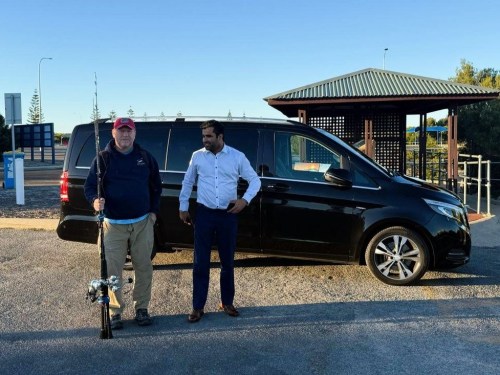
Wakeup was some ongodly hour, but you figure the limo driver – Vikas – was up well before that, and I could at least doze a bit on the way north. Once out of Perth, the scenery was just desolate seashore, beautiful but unforgiving. We passed through a few small towns, and a couple of hours later, entered Jurien Bay.

I make my entrance with Vikas.

There, waiting for me, was Captain Tom. (Who is Vice President of the Perth Game Fishing Club.) He was with buddy Brett, another PGFC member, Brett’s son Rhys, a friend of Rhys named Ledge, and finally, Tom’s young son Alfie. The older two kids were keen fishermen, and it immediately felt like I was heading out with friends rather than a charter, except that Tom was positively charged up about the idea of getting me a Samson and a Dhufish. He also asked me for any other species I was looking for in the area; I mentioned breaksea cod and baldchin tuskfish. He smiled quietly and said he’d be surprised if we didn’t see those.

Because we were 150 miles north, the weather report was a bit different than the Perth forecast. The morning would have some breeze, and as we left the harbor, I could tell it was going to be sloppy. This did not concern me. We stopped to jig for bait, and, while holding onto the rail for dear life, managed to add a bonus species – the Australian round herring.

(Close relative to a fish I caught in South Africa.)

It was around 11, and still fairly bumpy, when we set up for jigging. Two rather surprising things happened before I even got a lure wet. First off, Tom asked me to come up to the wheelhouse, which meant going up a ladder in risky seas. He pointed to the depth finder – which showed a large ridge with fish scattered above it. Innocently, I asked “Are those samsons above the ridge?” He smiled, looked me right in the eye, and said “The bottom is flat. The samsonfish ARE the ridge.”

Now that’s a stack of fish.

Positively drooling with excitement, I slid down the ladder and clipped a jig on my 50# setup. Brett had a quick look at my gear and verified it was 50#. He said nothing, but simply shook his head to indicate my rig wasn’t heavy enough. He pulled out a short jigging rod that looked like it should be employed on troublesome cueballs, and a Stella 20000 loaded with 100 pound braid. “You’ll need this.” he said simply. I let the jig fly.

We were in about 100 feet of water, but the jig stopped deal well short of that. I snapped back and missed, then got an unmistakable hit that ran a few yards of line and dropped. I instinctively reeled the jig up a few feet and got absolutely smashed, and the fight was on. The fish ripped 100# line off a screwed-down big game reel like it was in freespool, and all I could do was hold on. It hit the bottom a few times, but there was no reef to cut me off. Water was flying off the reel so fast it blinded me. Somewhere in there, I considered that if I had used my rod, I would have either broken it or been on with the fish for a week.

About 30 minutes into one of the more violent fights I have even experienced, I faintly sensed that I was moving the fish upward. I got two or three cranks up on the lift, and then the fish would surge downward. On that rod, with that line and drag setting, I guessed the fish had to be at least 40 pounds. I kept my balance and made even more progress, but then the fish would surge. But yard by yard, it was coming up. The seas were unpleasant, and keeping my balance was half the battle. I wondered if the fish would be any bigger than 40. Finally, I could see color deep under us – the gleaming flank and unmistakable amberjack shape. Tom had come down from the wheelhouse and was right there with me, cheering me on, and as I got to the leader, he grabbed the fish and swung it on board.

I had my Sampson. Twenty-eight years after Steve Baty had told me about them and their legendary fight, one year after an unsuccessful try for them, 9160 miles from home, I had my Sampson. And yes, their fight was indeed everything that had been advertised – the fish I guessed at 40+ was 22 pounds, and I’ve caught enough gamefish in my day to make generally good estimates. I yelled in triumph, I hugged anyone near me, and I watched in silent awe as we released the fish to fight another day.

Just for fun, here’s the video. Note the sea conditions.

There it is. After a quarter-century, there it is.

Tom was all smiles, perhaps a touch amused by how excited I was by a fish he can catch almost any day. The kids got fishing and each got a couple, and I was content to sit back and watch.

One of the boys does battle with a samson. Imagine being a teenager and living an hour from fishing like this. Good on Tom and Brett for being great Dads and taking the kids out so often.

He landed his faster than I did mine, on a lighter rod, and yes, his was bigger. He also didn’t announce it weighed 40 pounds.

By the time the kids were done, I looked up, and the seas had gone from crappy to completely flat. We motored out another few miles and began setting up for dhufish and assorted bottom stuff. Tom thought my 50# setup was too light for the dhus, and it was a touch intimidating to see what they were setting up – huge live baits and whole market squid.

One of my first drops on my rod got hammered. I battled the fish gamely, and had even started to move it off the bottom, when the line went sickeningly dead. Reeling up, I felt that the weight was still there, and when I got it in my hand, I was surprised to see that my 8/0 Gamakatsu hook had bent almost flat.

Brett took one look and said “Dhuey.” I have rarely felt so outgunned – if I had relied solely on my own gear, this might have been a different and even less interesting blog.

I tried a few smaller baits while my confidence recovered, and quickly secured a small grouper – the breaksea cod.

They are locally “black arse cod,” because, well, they are distinctly black around the rectum. It’s a medical term. Get over it.

See, I told you.

The next set, I got a solid hit and manageable fight, and landed a baldchin tuskfish – another one of my target list. I was up four for the day, the sea was flat as a pancake, and we still had hours to go.

Note the impressive dentition – hence, the name “tuskfish.” The locals call them “baldchin groper,” and I thought it best not to explain what this would mean in American English.

Now, it was about the dhufish. This meant going back to the humongous squid baits on an XXH trolling rod. I immediately got a big fish on, but the hook pulled after a few minutes. I reset and got another big bite, and this time, the fish stuck. It wasn’t as big as the previous one, but still pulled hard. Tom and Brett both said it wasn’t a dhufish – more likely a snapper. I asked what snapper they had that could pull this hard. “Pink.” they said. This did not compute for me – my largest pink snapper ever had been in Perth last year, and this fish seemed a lot bigger than that.

You know where this is going. It was a pink snapper. A beastly pink snapper.

I was in awe, but the guys seemed to regard them as pests. How far I had come from May of 2000 when I caught my first one-pounder with Scotty and was beside myself with joy.

I put down another big bait and got savaged, but didn’t land the fish. From there, I alternated my rods and theirs, and after a few more lost big dhus, I got a solid bite on my 30# rig and got it up off the bottom with no drama. I figured it was another grouper, but to my everlasting joy, it was a small dhufish. I had done it.

They all count, and, like golden trevally, they are prettier when they’re smaller.

Five species in a day, and all my targets scratched off – rescued from what, 24 hours previously, looked like a cancelled trip. All the variables had come together, and the Fish Gods had truly smiled on me.

We still had a few hours to fish, and it all went by in a happy blur. Several things of note happened – the kids each got nice dhufish themselves, and I latched into a bigger one (with their gear) and finally got it on the boat.

Brett and Alfie with a proper dhufish.

Yes, I know mine was smaller, but I’ll take it. These things are spectacular fighters.

I also landed a bigger baldchin, on one of my rods, just to regain some confidence.

As we were about to start the ride home, I couldn’t help myself and dropped a jig on my 30# setup. I knew this was tempting fate, but I just couldn’t help myself.

I got crushed. The fish ran me hard along the reef, searching for a sharp edge it didn’t find. I held on for dear life, and it kept peeling line out to the left of the boat until it was well past us. As it turned around and swam downcurrent, I gained back some line, but 30 pound braid suddenly feels awfully light when you’ve got something serious on the other end. Oddly enough, neither Tom nor Brett seemed all that impressed, and guessed it was another pink snapper. “No way,” I said. “This thing has to be at least 15 pounds.” Even bearing in mind my horrible missed guess on the Samson, I was confident on this, but Tom kindly explained that the snappers here do regularly get that size – and bigger. Indeed, they get to at least 18 pounds, because that’s exactly what they swung over the rail a few moments later.

Pest or not, the pink snapper has been a glamor fish for me even since my first one, and I was ecstatic to close the day with a trophy. It was years before I caught one with a proper hump on the head.

Passing one of the coastal islands on the way home.

The ride in was smooth and quiet, and as we tied up, I couldn’t thank Tom, Brett, Rhys, Ledge, and even little Alfie enough. Out of the kindness of their hearts, they had rescued my trip and given me one of the most epic fishing days I will ever have.

The gang at the end of a very long, very memorable day.

The three hours back to Perth went quickly with Vikas at the wheel, and I timed my arrival in Fremantle with the delivery of a Crust Fremantle extra-large pepperoni pizza. I walked out on my balcony, ate the entire pizza, and looked out over the quiet harbor onto the Eastern Indian Ocean that had finally given up a Samson – and a host of other marvelous species. And I was grateful. Grateful for living long enough to get here, grateful for having the opportunities to travel to so many exotic places, grateful for the kindness of so many strangers to make the trip happen, grateful to the fish and weather for finally cooperating, and grateful that there were still thousands of species out there, although I hope my next obsessive target doesn’t take 28 years.

Steve


Posted by: 1000fish | June 23, 2026

An Afternoon in Perthatory

DATELINE: MAY 17, 2025 – FREMANTLE, AUSTRALIA

For as many times as I have been to Australia – roughly 50 – I had spent very little time in the western part of the country. Indeed, my only excursion there was last year’s adventure to Perth and Exmouth. Epic fishing to be sure, but I left without encountering my main obsession in the region – the Samson Fish. These freakishly-strong amberjack relatives inhabit the reefs of Western Australia, and I have longed for one since the first time Steve Baty told me about them over a beer in 1997. They are a common jigging target, but alas, my days in Perth last year were far too windy to give them a proper shot. As you of course recall, I vowed at the end of that blog to come back for a rematch.

So here I was, a year later, heading to Australia for a business trip. I scheduled a long weekend before the meetings to try again. The weather looked great, and I set up two full days with guide Allan Bevan, a local superstar who excels at both samsons and dhufish, another local gamefish I hadn’t gotten last year.

It’s a long, long way from Alamo, California to Fremantle, Australia. Fourteen hours from San Francisco to Sydney, a layover, and then five more hours to Perth. I landed on a Friday afternoon, hired a car to run me around for bait and Red Bull, then to my hotel – Be Fremantle – which is right on the water to facilitate shore-based fishing. (The same spot where I added the elusive tommyrough to my species list in 2024.)

The weather continued to look outstanding. I grabbed my gear, walked all of 100 feet to the jetty, and started baiting hooks. It is always such a satisfying feeling to fly that far and have it all work out. 26 hours after I walked out my front door in California, I sat down on the rocks and started fishing. First, I cast a big slab bait – there just had to be some unusual rays out there. Then I tossed some smaller baits. Plenty of the usual suspects showed up – puffers, butterfish, gobbleguts, bream, and tarwhine were there in numbers. Oddly, there were no trumpeters, which did not break my heart – perhaps the 9000 of them I caught last year had gotten the message and had moved elsewhere.

Around 6pm, I got a small strike on a sabiki tight to the rocks, and pulled up a cardinalfish that got my immediate attention, because, well, I had never seen one quite like it.

A quick look at Hutchins’ Sea Fishes of Southern Australia verified it was a Western Striped Cardinalfish, and I was on the scoreboard.

Moments later, I got a whiting that looked slightly different from the dozens of others I had already gotten.

Thanks to Dr. Jeff Johnson, it was identified as a yellow-finned whiting, species two of the trip. I had been on the water less than 90 minutes.

This was also my 11th whiting species, caught mostly in Australia, but also in places as diverse as Thailand, Japan, and Israel. I think this is the last one that can be identified without a team of scientists present.

It was a pleasant evening, and the slight breeze had dropped off to almost complete stillness – boding very well for the next two days offshore. I was considering getting some sleep when the larger rod sagged and started paying out line. I carefully picked it up and opened the bail – something was chomping on my squid and moving off toward the harbor entrance. I let it swim a few yards, then reeled into the circle hook. Whatever it was pumped hard a few times and tried to swim back into the harbor, but it wasn’t big enough to take any line off the Thunnus 10000. I prayed silently that it wasn’t an eagle ray. Moments later, a familiar but unfamiliar face came out of the depths – it was a fiddler ray, but the southern version, so a new species and likely a world record. It was barely hooked and just out of reach, so without hesitation, I jumped onto a submerged rock and landed the fish. My low hikers could dry.

Three species and a world record in one short evening. And the main event was yet to come.

A gorgeous night in Fremantle harbor. Or harbour.

Dinner, by a coincidence I’ll call happy, was with old buddy David, who happened to be in town.

There we are, saying hello to a co-worker.

The Tourist Wheel on the Esplanade, one of Fremantle’s nighttime sights, and an excellent navigational marker for the overserved.

When I got back to the hotel, I marveled at the perfect weather and gorgeous forecast. The big game was in play for tomorrow, and Allan texted and said “All systems go, see you 6am at the wharf.” I went to sleep content with a good day and looking forward to a better one.

It is usually at these times, when all seems right with the world, that disaster strikes. I got up early and walked down to the landing. There was Allan, but his face told me that something was terribly wrong. “Oh #@%$” I thought. The situation was indeed dire. The drive train on his boat had blown, but might be fixable during the day. In the meantime, he had arranged for me to go on another boat with local skipper George and a small fishing club group. We would mostly focus inshore, but there was still some chance at a dhufish and certainly a shot at whatever oddball might be swimming around. It was better than nothing, and I was grateful that George and company welcomed me along. But I was dying to know how we could work out a big game trip the next day.

I set my jigging stuff aside and rigged for lighter reef fish. Things started well – I got a strong hit on a #4 hook and whatever it was ran hard on my ten pound braid. When it finally surfaced, I was surprised to see a very large damselfish – well over a pound. Swinging it on board, I could see it was a scalyfin, cousin to a species that I had gotten in Sydney years ago.

It turned out to be McCullough’s scalyfin, species four and record two of the trip.

I settled in for what I hoped would be a species bonanza, but the Fish Gods, unsatisfied with destroying Allan’s boat, shut me down. I caught plenty of stuff – there were flathead, whiting, and wrasses everywhere, but these were repeat customers. I kept in constant touch with Allan, hoping with all my might that his boat could be seaworthy for Sunday. I snooped around Google a bit, and it didn’t seem like there any charter alternatives for deep jigging, so I tried not to consider that I might have flown an extra ten hours to miss my targets a second time. I knew I could stick it out on the shore, but it dawned on me that I might need a third trip to get the Samson, and I wasn’t sure I would ever get weather this perfect again.

As we got to lunchtime, Allan’s texts took a dark turn. There was no way his boat would be ready. I asked about alternatives; he said he would call around and get with me if he could find something, but he had his doubts. In the meantime, I kept fishing. While the species weren’t happening, I had plenty of fun and managed to land two fairly large wrasses – a brown that broke my record from last year, and a western king that qualified for an all-tackle.

The brown, four ounces bigger than last year’s fish.

And the western king, one of the best-looking wrasses in the region.

I had been fishing less than 24 hours, and had four species and four records. But all I could worry about was how in the world I was going to get on the water Sunday. I needed that Samson. There was no news from Allan, which could have been good or bad, but for now, I was in purgatory. In Perth. So Perthatory. (This was Marta’s idea, so blame her. There’s also a Sylvester the cat joke in there someplace, but I’ll leave that alone.)

Steve and George at the end of a solid day.

We got into harbor late afternoon, and I should have been thrilled with the species and the records. But as I said goodbye to George and crew, I was heartsick at the idea of not getting out the next day. I had searched far and wide, a hundred miles in each direction, and found nothing. I spoke to a couple of IGFA guys, but both were offshore trolling specialists. Allan had gone silent, and I bravely prepared my gear for the evening session, not accepting defeat but having no idea what I was going to do. Those fish were out there, perhaps 20 miles west, so close, but so far. Allan was really my only chance at a connection, and it wasn’t sounding positive from him.

Just after 5pm, I was back at my hotel, mournfully planning out a long night and day of shore fishing, when my phone rang. Prepared for what would either be tremendous news or a crushing blow, I picked it up to answer.

Steve

Posted by: 1000fish | May 5, 2026

Spearfish Anonymous

DATELINE – MAY 6, 2025 – KONA, HAWAII

There should be a support group for people who can’t catch a spearfish. “Hi, my name is Steve, and I can’t catch a spearfish. I’ve been trying for 19 years.” And the group would respond “Welcome, Steve.” There would be hugs, crying, and cookies. The problem is, there aren’t 12 steps to get out of this group, there’s only one – catch a spearfish – and that pursuit alone is enough to make me want to attend a lot of other meetings.

Yes, I went for spearfish again, and yes, I failed. There is a fine line between persistence and stupidity, and I have been over that line with both feet for years. It’s going to happen someday, and when it does, the first thing I will do, after I put my clothes back on, is write an epic tribute to the journey. But in the meantime, I was still in Hawaii and there was fishing to do.

I did the one thing guaranteed to make any fishing trip more exciting – I brought Mark Spellman. It had been a while since we had gotten out together, and what better place than the leeward side of the Big Island? I could barely imagine what new disasters he could brew up.

Mark Spellman. He is an excellent tennis player, but unfortunately, this blog is not about tennis. This photo was taken before he put on sunblock.

Lining up to land in Kona. There’s a spearfish in this picture someplace.

We set up three days with legendary Kona guide Dale Leverone, with a shore day on either side.

Captain Dale Leverone – if you’re ever in Kona, he’s the guy to book –  https://www.konadeepsea.com/

To bring some sanity to the venture, I invited Jamie – she’s busy at work, but still loves to get out on the water whenever she can, and she is Spellman-trained. The fact she is in her late 20s is troubling to me, but I try to ignore how old that makes me. I always say that age is just a number – just like blood pressure, lipids, and PSAs.

I will admit it’s a little unsettling to see her, because every time she walks around the corner, I expect Wade to be right behind her, with a fishing rod in one hand and a pizza in the other. Good God I miss him.

As is routine, we started at the Kona pier.

Spellman and one of those photobomb looks only he can give.

There was instant justice. On my very first cast, I caught a Whitley’s trunkfish, the exotic species Jamie had pulled from under my nose last year.

Joy to weight ratio: extremely high.

My joy – and related hubris – lasted all of 10 seconds, because that’s how long it took Jamie, on her first cast, to pull up another damn fish I had never seen before.

A yellowtail coris. You have to be kidding me.

The next morning, we headed out into the blue Pacific off Kona.

Putting out the trolling spread, in those first few moments of the trip, when there is still hope.

It’s not like we had a bad day trolling – we just didn’t get a spearfish. We all caught some decent yellowfin.

These things pull hard, especially when I break out a spinning rod and throw metal jigs at them.

Then it got weird. Trolling back over where we had gotten the first set of bites, we had a big pulldown and run. It was Jamie’s turn in the chair, and she sat down, took about five big cranks, and the line broke. 120 pound line with a 500 pound leader. Broke. Jamie reeled in the loose end, and it looked like it had been sliced off with a knife. We all guessed wahoo and circled back. The side rigger snapped off and the Tiagra 80 started peeling line. I jumped into the chair, knowing the behavior wasn’t spearfish but not wanting to take any chances. It was a solid, strong fish that stayed deep with a lot of head shakes. After about 15 minutes, I started gaining line – it was a heavy, head-shaking fight, not the speed of a tuna but plenty of muscle. Moments later, we had a partial answer – a dark shape surfaced well behind the boat and we could see it was a shark. I was disappointed it wasn’t a spearfish, and I wanted to get it to the boat so we could knock the hook out and release it – Hawaii does not permit deliberately fishing for shark, but of course we can’t help it when one takes a shine to a trolling lure.

It stayed deep until the last few cranks. and when I got it on top behind the boat so the mate could handle it, I was stunned. Jamie actually spotted it first – “Oceanic Whitetip!” This is a rare, open-water fish, rarely seen from sport boats, and I had (accidentally) brought one to leader.

Chris released it safely, but I had added a most unexpected species.

Oceanic Whitetip postscript – Jamie, who works with the NOAA folks, let us know that each of these fish has a unique pattern on its dorsal. She submitted a photo of mine to the researchers, and it turns out that this one had not been recorded before, so I was given the honor of naming it. So now, there is an Oceanic Whitetip shark named Lorenzo Von Matterhorn. (Look it up, and for the record, Marta hated the show.)

We spent the evening on the pier again, with nothing new to report except an excellent burger at Quinn’s Almost-By-The-Sea.

I’ve caught hundreds of raccoon butterflyfish. but they’re always worth a photo.

The next morning, we were back out on the troll. Occasional radio reports of a spear here and there kept our hopes up, but it was not my day of destiny.

An inevitable result of old people trolling for five hours.

Mid-afternoon, we headed inshore and hit some favorite bottom spots. Jamie’s favorite fish to eat is peacock wrasse (locally called Nebeta,) and we racked up quite a few of those.

Part of the razorfish family, they are supposed to be delicious, but be warned – they bite.

Then came a brief moment of ill-conceived triumph followed by weeks of despair, so now I know what Cousin Chuck’s honeymoon felt like. I pulled up a black razorfish. I have never caught a black razorfish. Ergo, I assumed and celebrated a new species.

But it turns out to be a black color morph of the same old Nebeta. Imagine how well I took that.

It was still fun to catch a batch of tropical fish on light gear, and just as we were getting ready to leave, I had a strange, small bite and an equally odd fight. I swung my catch over the rail, and, to my delight, it was something I had never seen before, except perhaps in sweaty late-night reading sessions – a snake eel.

A sharpsnout snake eel, to be precise – species 2385. It was around 18 inches long but thinner than a pencil.

Day three began with a positive sign from the Fish Gods – a rainbow. Needless to say, for the trolling portion of the day, that was the last positive sign we had. The spearfish were there, we just needed to have the right day.

But it was a lovely rainbow.

Begrudgingly, we moved to some bottom spots late in the day, and the first fish I caught was a blueline triggerfish, an old friend that always seems good for a world record. Sure enough, a quick weighing showed it was four ounces bigger than last year’s record, and I was on the board with record #244. So that was good news.

One of the more reliable world record fish in the ocean, the blueline has accounted for four of my certificates.

Then Spellman got one exactly the same size, adding his sixth world record.

Nice work. And yes, Marta noticed that Spellman’s fish was bigger than mine, but the scale I use for world records only weighs in four-ounce increments.

Speaking of blind pigs and truffles, Spellman proceeded to run off an astounding string of quality bottom fish, while I continued to catch nothing but blueline snappers. What the hell? He opened with a strong scrawled filefish, just a few ounces off the record.

Called “broomtails” locally, this species gave me fits for years.

He continued with a nice island jack, which was about three times of my personal best on this species.

Ok, I get it. You can stop now. Or at least let the fish poop on you for a better photo.

He then got into his strongest fight of the session, several minutes of tough runs back to the reef, before he landed a beastly Pfleuger’s goatfish. I held my breath as he weighed it – it was less than a quarter-pound from setting another record.

Giant sigh of relief, because it’s my record he would have broken. Jamie was cheering for him, which was hurtful.

Dale quietly trolled us a couple of extra hours, but we finally had to head back to port so I could be on time for my Spearfish Anonymous meeting. Sure, I wasn’t thrilled I hadn’t conquered an old adversary, but I had also gotten three new and rather exotic species, spent time with some of my best friends, and even more importantly, given myself a reason to come back to Hawaii soon.

Steve

The gang – Mark, Chris the deckhand, Captain Dale, Jamie, and the guy who hasn’t caught a spearfish. Yet.

Posted by: 1000fish | April 5, 2026

Half a Day in La Libertad

DATELINE: FEBRUARY 18, 2025 – LA LIBERTAD, EL SALVADOR

21 years ago, Marta and I transited through San Salvador, on the way to a magnificent week in Costa Rica and Panama. It wasn’t a long layover, perhaps 90 minutes, and there were no decorative water features in the airport, so I didn’t catch a fish in the country. I briefly hinted that we stay overnight just so I could find a fish to add, but this was still when Marta had some hope I was normal, so I dropped it.

As all of you except Cousin Chuck have figured out, Nicaragua is immediately south of El Salvador, and since I was in the region anyway, it was time to correct this situation. Apart from the 96 countries where I have caught a fish, there were four I had visited without fishing – The Vatican, Russia, Venezuela, and El Salvador. (For you scoffers, I do indeed have a plan for the Vatican.) So it was just 45 minutes flying from Managua to San Salvador, but then, I would need to find someplace to actually fish. El Salvador, like Nicaragua, does not have the sportfishing infrastructure of, say, Panama, but there are still some great places to fish. The seaside town nearest the airport seemed to be La Libertad, so I started my search there.

Oh yes I did.

This is where the IGFA was, as always, supremely helpful. I looked up the local IGFA rep there, Paco Saca, and he responded immediately with several suggestions, ranging from full-on big game to some inshore options. (This type of access is one of the many advantages of being an IGFA member – you can sign up on IGFA.org or just contact me for details.)

Black Bart International,...

Paco on the water.

Paco put me in touch with Frank, who is nicknamed “Mamba” – likely by the fish. He runs inshore and offshore trips in pangas around La Libertad. Frank got back with me right away. We discussed some full day options that he thought could get me into some big fish, but alas, I really only had time for a half day, and once I explained my bizarre needs, he enthusiastically set up a shorter trip on the local reefs, just so I could say I caught something there.

This was the first picture he sent me. While I do have all the species on the table, it was very clear the guy knew what he was doing.

I had to make this a brief visit – just a day to get the country added, and then back to the US and real-life responsibilities, like work and avoiding the dishes. Frank recommended the Hotel Acantilados, as it was right next to where we launch the boat and happens to be the nicest property in the area. Their driver got me at the airport, and got me to the hotel in less than an hour. The place was absolutely gorgeous – carved right into a seaside cliff with views in every direction. (And quite a bargain. This is not a bad place to visit if you’re in the region.)

The view from the sitting room in my hotel.

And from the balcony. This was flat-out luxurious, and yet it cost less than the Holiday Inn Fresno.

Frank was on Whatsapp with me from the moment I landed, and we agreed to meet at 6am the next morning.

He got me right at six and we drove all of five minutes down the coast to launching area. The boats were surf-launched, which gave me a few South Africa flashbacks, but looking at the calm conditions, I realized it would be a cinch.

The scenery just couldn’t have gotten any nicer, unless there was a fish in the photo.

Our craft for the day, the Mario Albeiro. That’s Spanish for “adenoids.”

Frank and Steve enjoying the flat ride on a beautiful day. Marta seemed to want to see more pictures of Frank than the fish. Yeah, yeah, yeah.

The shoreline in the area is mostly cliffs, making for amazing scenery.

We stopped a few times and cast I cast a small spoon around. Frank still believed that we should get offshore with some bigger lures, but I doggedly stayed with my time-honored strategy of staying inshore and going smaller and smaller until something – anything – bites. Maybe 30 minutes into the actual fishing, I had dragged out a sabiki, but not yet gotten desperate enough to put bait on it. After a few casts against the cliffs, I got hit and a fight was on. Realizing this might be my only chance to add an El Salvador fish added some pressure to the situation, but I managed to ease it to boatside – it was a green jack, the Pacific version of the Blue Runner, and I was on the scoreboard with country number 97.

The boat driver did an excellent job of not looking perplexed at my joy.

We bumped around a few other reefs, and more catches started showing up. The ubiquitous chameleon wrasse started biting – the most common creature in the ocean from Puerto Vallarta to Nicargua.

I got my first one in Puerto Vallarta in 2008.

Then things got interesting, at least by my standards. I caught a small, groupery-looking thing, and recognized it as a mutton hamlet. But it didn’t look quite like the Mutton Hamlet I had caught in Puerto Vallarta all those years ago, so I did the logical thing – I called Chris Moore. Chris is a High School teacher, so not only do we expect him to know everything, we also expect him to babysit our badly raised children. He informed me that there are indeed two species of Mutton Hamlet, the Pacific and the Rivulated. The key was the pattern on the pectoral fin.

The beast in question – species 2382.

This is what differentiates it from the regular mutton hamlet – rough rows on the pectoral fins instead of scattered spots.

We trolled most of the way back, but alas, there were no hits.

Dinner was steak and lobster at the Acantilados – it was perfect, and yet cost less than a visit to Chick-Fil-A.

No, this was not the airport shuttle.

I got to bed early that evening, because the United flights out of Central America all depart at ungodly predawn hours not suited to most humans. Morning came too soon, because I had to leave for the airport at 2:30am, but my driver was punctual and I got to San Salvador with plenty of time to spare, so I could be there in person while United created drama around my homeward flight and I ended up having to go through LA with a 35-minute connection instead of Houston with a two hour layover. Miraculously, I raced through customs and managed to get by the surliest of gate agents and on to the flight. It would be just a week until I had to get on another plane, but unfortunately, that trip was a work thing someplace frozen that had no fish anyway. The next fishing trip, now that we will pass the compendium blog that started 2025, would be a May journey to face a very old adversary.

Steve

Posted by: 1000fish | February 16, 2026

An Apology on Behalf of Oliver North

DATELINE: FEBRUARY 16, 2025 – SAN CARLOS, NICARAGUA

While I’m proud to be an American, it’s much easier to be proud about this when I ignore our military misadventures in Central America. My high school and college years were loaded with Iran/Contra and similar foibles, but the USA actually invaded Nicaragua as early as 1911, when the locals had the nerve to elect a government unfriendly to William Howard Taft. So, on behalf of him, and especially on behalf of Oliver North – sorry. And I was hoping the people of Nicaragua wouldn’t hold all this against me when I went down there to go fishing in February of 2025.

Nicaragua is a tremendous fishing destination, with loads of fresh and saltwater species. It doesn’t have as much infrastructure as Costa Rica, but it’s a lovely place with a few hidden gems for fishermen, and this post is going to unhide one of them.

The idea for this trip was hatched in the fall of 2024. With Covid seemingly under control, I started looking seriously at my country list again. With the addition of Tahiti, I was sitting at 95 countries fished. (And four more I had visited and not fished – Vatican City, Russia, Venezuela, and El Salvador.) Nicaragua isn’t too long of a flight, maybe eight total hours including connections, and it has some big deal stuff for us species types, notably rainbow bass and tropical gar. I missed a chance to get a rainbow bass in Costa Rica years ago, when Marta insisted we go look at monkeys in some rainforest rather than go fishing. What was I thinking?

I could also expect to pass the time catching tarpon and snook – Nicaragua has some serious game fishing in its coastal rivers. Finding a lodge took some doing, but the internet is a wonderful place as long as Marta sets up the filters correctly. I finally landed on La Esquina Del Lago, which then also turned out to be recommended by the guys at Hi’s Tackle Box.

The owner, Rob Hoover, did a great job of patiently listening to all my bizarre requests and custom-building a schedule around species hunting. I don’t think I’ve ever been better-prepared for a trip.

That’s Rob, with a fairly typical San Juan snook.

The most expensive part of the trip was making up to Marta the fact that I would be gone over Valentine’s Day. She’s a reasonable person, but she wasn’t going to let that go without a shopping spree in Alamo Ace Hardware’s kitchen section. And one La Creuset Dutch Oven later, I was off to the airport and heading for Managua.

The flights were easy enough, but what I hadn’t counted on is that the drive from the airport to the lodge would be just shy of four hours. My bad for not researching it – I should have brought more coloring books. My driver, Favio, was a pleasant, considerate soul who didn’t utter a word of complaint about my constant requests to stop for Red Bull or Cheetohs.

Favio navigates a not-uncommon cattlejam.

The countryside was gorgeous – as we got out of the big city, we could see mountains to our left and Lake Nicaragua – which is just HUGE – to our right. We passed through quite a few small villages, each one with cold Red Bull available, and a lot of forest and the edge of some deeper jungle.

This one is apparently an extinct volcano.

It was just getting dark when we arrived in San Carlos, a charming river village at the intersection of Lake Nicaragua and the Rio San Juan.

San Carlos, Nicaragua.

Even though we were physically closer to the Pacific, the river drains into the Atlantic, and contains a surprising number of saltwater species, including bull sharks. (Don’t swim here.)

I got settled in, unpacked and assembled my gear, and got a pint of boiled water for one of my freeze-dried REI camping meals. (The food here is excellent, by the way – I’m just paranoid.) The rooms were spacious, comfortable, and air-conditioned, and the staff was hospitable as could be, albeit bewildered by my food choices. The dining area and clubhouse featured at least a dozen rainbow bass mounts – the main fish I wanted to catch on the trip.

They really can get this colorful.

The clubhouse. I want the name of their decorator.

The resort dog. His favorite food was whatever I was eating.

February is supposed to be starting the dry season in this area, but the Weather Gods didn’t get the memo. The morning was drizzly and overcast, and while it was warm enough to make a t-shirt all I needed, it wasn’t the 90+ I had expected. The guides, Walter and Maynor, were clearly expert, and their English was much better than my Spanish. We headed east down the San Juan River, and after about an hour run, we were ready to fish.

That’s Walter driving and Maynor in the black – my constant companions for four days.

Our craft was the Julia Brava.

It’s never easy to explain species fishing to a normal person, but the first few hours were easy, because their normal trolling and casting tactics translated well into some of the stuff I wanted to catch. I always overpack lures, because I own more lures than I could ever use in three lifetimes. It’s always interesting that only a few of these lures will ever catch fish, but you never know which few. In this case, both guys immediately pointed out a red Bomber crankbait I had only tossed in at the last minute – I think of it as a local bass lure, and hadn’t considered it for more exotic quarry.

The red Bomber. Mind you, it was brand new at the beginning of the trip.

We hadn’t trolled for three minutes when one of the rods started sagging. I started reeling up and could feel the occasional tug, so it was clearly a small fish. It turned out to be a bigmouth sleeper, a fish I had previously caught in Belize, but I was on the board for Nicaragua – country number 96.

On the scoreboard!

My first bigmouth sleeper, with Chris Harris (of the fabled Chris and Sue Harris duo that ran an awesome lodge near Monkey River) exactly 20 years ago. That was species 494.

We continued and caught a batch of machacas, a river species with surprisingly nasty teeth that I believed I had caught in Belize in 2005.

A machaca – spirited fighters that will take almost any lure.

Machaca teeth. Do not put this in your pants.

Of course, I took careful photos, and months later, as I was rooting through the references for my original fish, I ended up off on an internet ID journey that, after several months of intermittent effort, resulted in at least finding the keys for what turned out to be around a dozen possibilities.

Somewhere in there, I brought in the one-man committee of experts – Dr. Alfredo Carvalho of the University of Sao Paulo. I can’t ever thank him enough for the hours he has spent poring over these detailed and often-conflicting descriptions. The answer was delightful and yet humbling. The Nicaraguan machaca was indeed a new species – Brycon costaricensis, vs. the Belize fish being Brycon guatemalensis. But the humbling part was that only my first Belize machaca was guatemalensis. The remaining ones, smaller specimens I had caught in a more inland river, were all costaricensis. So I had just added a species I actually caught 20 years ago.

My original costaricensis, which had hidden in plain sight for two decades. Thank you Alfie!!

It was quite a journey. If I had a missing sibling somewhere, one who was so horribly demented and vicious that my parents kept her under the stairs and then in a series of secret asylums, I could have found her much more easily than I found this species. And no, my sister did not grow up under the stairs. I think.

A few fish later, I reeled up something I didn’t recognize. It was clearly a grunt, but it took a good deal of research to narrow it down to a Burro grunt – a Caribbean species that migrates up the river that time of year. I was up a species, and it was one I hadn’t even heard of.

The grunt, species two of the day.

We trolled through a few more machacas and some small snook, and then I talked the guys into doing some bait fishing off the bank – this is where I figured I would catch any catfish that might be running around, and have a shot at the smaller fish that would likely be up against the shoreline.

The micro fish didn’t disappoint – I loaded up dozens of tetras, which all turned out to be roundnose tetras, but a species is a species.

My light bait rod also kept busy, and I landed a mixed bag of small cichlids and catfish. The cichlids, always an ID problem, narrowed down to either wild midas or redhead cichlids, so nothing new there. The catfish were almost all Rhamdia quelen, the South American catfish I have caught in Argentina, but one of them looked different, so I took loads of photos.

About a month later, Dr. Alfredo Carvalho pinned this one down to Rhamdia guatemalensis, a new species for me, and, oddly enough, the only catfish I caught that wasn’t the regular R. quelen, which, as you all know, I caught in Florida with Dom Porcelli.

The next day was a biggie – we would head to the lake and make a major effort for rainbow bass. San Carlos is in the very southeast corner of Lake Nicaragua, and as we motored out onto the open water, it hit me how darn big the thing was. I couldn’t see land to the north or west.

Moonrise over Lake Nicaragua. This photo would make a diabolical 1000-piece puzzle.

After half an hour or so, some islands came into view, and the guides made it understood that we could fish near these, both trolling and casting.

The action was immediate – every crankbait I threw got hit. Unfortunately, these hits were all from larger versions of the ubiquitous cichlids, but the guys encouraged me to stay at it, because there are supposed to be rainbow bass mixed in with the other fish.

Wild midas cichlid? Melanura? Who knows. But they hit everything I threw at them.

The deep-diving version of the fabled Ilex “Chubbie” lure was a favorite.

I took a break from the casting to drop some small baits, and was immediately rewarded with a tetra that was clearly different from the ones in the river.

They turned out to be longjaw tetras – species #4 of the trip. Note the teeth.

We shared the island with a variety of wildlife, including these roseate spoonbills, one of Marta’s favorite birds.

About an hour later, we set up to troll, and after picking through all three boxes of lures I brought, they again insisted I use the red Bomber. They were looking for deeper structure – dropoffs, rockpiles, and submerged wood – which took a lot of skilled boatmanship because we kept going in and out of the wind. It also rained on us a good part of the day – not normal for this time of year, but it was what it was. I was in Nicaragua and I wasn’t going to let some rain keep me from a species. We had a few false alarms with snags, but we also had a few short strikes. The guys kept moving us – there were quite a few islands, and they were unflappably confident we would get a rainbow bass.

Well after noon, I got an unmistakably bigger hit. The fish ran hard for a moment, then the hook pulled. I didn’t have to be told what it was. We went back over the same dropoff, and just as we started to turn around, my rod slammed down. I set back hard, and I had something very solid on the line. It took about five minutes to get it close – the fish wanted to stay deep and we were trying to hold place in the wind, but it finally surfaced. It was a solid rainbow bass, about five pounds, and I was just a few feet away from getting a species I had wanted ever since I read about it in some magazine back in the 1980s. It was an agonizing few seconds as we eased the boat closer to the fish, but Walter reached down and deftly scooped it up. I had my rainbow bass.

Not a monster, but a solid fish. I like catching things that have humps on the forehead.

We spent the rest of the day going back and forth across the back of the islands, and got two more decent rainbow bass, plus a ton of other cichlids.

The second fish. Smaller but humpier.

A juvenile, which was safely released.

And one more photo just because I wanted to.

We headed back to the lodge, and just as we pulled up, the skies opened and we had torrential rain for about two hours.

Leaving one of the islands behind us.

I tried the dock later that evening, but the action was limited to more roundnose tetras and a few catfish. Dinner was a slab of grilled rainbow bass, which was excellent – and a bag of REI lasagna.

I have to emphasize that the food here looked excellent and they have never had a problem with anyone getting ill. Indeed, my worst case of food poisoning ever, a three day Parisian pukefest, originated at a high-end French seafood restaurant.

The tropical gar was my remaining big target, but I figured that it wouldn’t be a problem if we headed downriver and fished big cut baits. Plenty of my friends have been in the region, especially Costa Rica, and seen loads of them – the trick is getting them to stay on the hook. Maynor and Walter were confident we could find a few, but they did communicate that the water was rather high and the fish might be a bit harder to find.

We headed out that third day with high hopes, but the rain soon put a damper on things. It poured for long stretches of the day, and while we saw a few gar boil, we didn’t get so much as a hit. This was still not a disaster – I had my main target and I just needed to get lucky once. One of the other guests at the lodge, a guy in his 20s who had saved a good while to make the journey, was focused solely on catching a tarpon on the fly, and these were not the right conditions. He went at it, rain or shine, for four straight days, and raised and missed two fish.

At least the dog loved him.

Note that this place is usually jammed with tarpon in February – he had just gotten the wrong week. The Fish Gods will do that.

The sole bright moment in my otherwise waterlogged outing came on a micro rod, when a single silverside broke up a steady stream of tetras.

So I was up to seven species, but now I only had one day left to catch a creature I had assumed would be much more evident that it had turned out to be.

The next day, after a healthy breakfast of REI oatmeal and Red Bull, we headed a couple of hours downriver.

Heading into the sunrise in search of tropical gar.

The weather was a little better, but we still went through intermittent rain most of the morning. It was clear why they spent the time to bring me all this way – we got into a section of river that had a series of tributaries and small bays set back from it, and they felt that these areas would give us the best chance at a gar.

We set up two rods to fish big slab baits, and as we lowered them back, as an afterthought, I picked up a crankbait rod, this time with a deep-diving silver and green Rapala. The guides had mentioned that gar would occasionally take an artificial, so I figured I would cover all the bases. I fired it out almost to the bank, and then slowly reeled it tight until I could feel the lure thumping in the current. I started working it back to the boat, and seconds later, wham. And not to confuse it with the 1980s musical geniuses, but I mean WHAM! Something absolutely crushed that lure. I waited a split-second to set the hook, which I owe to years of crankbait training with Jim Larosa, a good buddy who wins his share of bass tournaments despite the fact he dresses like a colorblind bowler, and the fight was on. Whatever I had was by far the largest fish I had hooked on the trip, and I found myself, bizarrely, praying it wasn’t a tarpon or huge snook. Yes, species fishermen find themselves saying prayers like this. I didn’t say it was normal or healthy.

The fish peeled line off the reel, then cut across the current to calmer water. I was pretty sure it wasn’t a tarpon, because it hadn’t jumped, but it could have been a monster snook. I looked at Walter and used my one word of Spanish. “Robalo?” “No, no,” he replied. “Gar.” I still couldn’t be sure. The fish made three or four more runs in and out of the current, slowly getting closer to us. If it was a gar, it was likely not hooked well, and I knew we would have just one good chance to land it.

About 15 feet from the boat, it surfaced. It was a gar, and a big one, with the crankbait well into its jaw. I walked it as far forward as I could, and Maynor reached down into the water and flung it into the boat. I had my tropical gar, which of course made me think I needed to go to Cuba immediately so I could finish the genus.

The trip was now a complete success.

Again, do NOT put this in your pants.

We took our time heading in, and we put the red bomber back and began trolling just to see what we would get. After a couple of machacas, I got a much more serious hit – something that peeled line and headed for the top of the water to roll around. I thought for a moment that I had another gar, but as we got closer to it, it jumped. It was a snook, and a good one. I knew I had shaken a few this size, and I could tell it would be my personal best if we could get it onboard. Walter, sure-footed and deft of hand, made short work of it and I had an eight-pound snook.

It’s not Arostegui-level, but I’ll take it.

The Red Bomber was such a winner for the trip that I am hereby establishing Wozniak’s Lure Hall of Fame, and this is the first entrant.

The Bomber also got several bright red cichlids, but alas, these seem to be color morphs of the same old species. If anyone can help with these, you know where to find me.

Dinner was a slab of that aforementioned snook – delicious grilled with lemon – and a bag of REI chili. (I bring my own tabasco.) I fished well into the night at the resort, and managed one more additional species, a moga cichlid, which was incredibly beautiful because it wasn’t one of the standard ones.

That was nine for the trip, and 2381 lifetime.

It had been an amazing journey, and a remarkably easy one. I can’t recommend these guys enough.

Walter and Maynor as I headed home. I have fished with guides all over the world, and these guys were top-notch.

This is Champa, the general manager – this guy makes stuff happen.

The following morning, Favio picked me up again, and we were off to Managua. It went by quickly, mixed in with some Red Bull stops, and at last, we were back where it all started just a few days and nine species ago. I smiled at the familiar sight of a United 737, but then, to the great surprise to those of you who don’t know me all that well, I walked past it and boarded an Avianca plane, heading for … well, let’s just say the central American adventure wasn’t quite over, and that a 20 year-old mistake was about to be fixed.

Steve


Posted by: 1000fish | February 4, 2026

Sweet Coralline

DATELINE: APRIL 5, 2025 – THE MOST ISOLATED PART OF NEVADA IMAGINEABLE

At this stage of my career, I often find myself going long distances after a single target, usually revisiting a location I hit before and cleaned out the easier stuff. This gives me something to do when Marta is off at yoga retreats, but the disadvantage is that it’s hard to build an interesting blog (and “interesting” is a highly subjective term here) around that one species.

Therefore, to save you four single-species writeups, I have combined these trips into a single post, mostly because Marta keeps sending me editorial notes like “TLDR.”

Administratively, this one will be a little confusing, because I’m lumping in four trips, starting with one in January 2025 and finishing with one in April. The next blog in sequence, a magnificent and much more readable journey to Central America, occurs in February, so that should restore your timeline to normality and keep this from reading like a Marvel movie.

PART ONE – REDONDO BEACH, JANUARY – (Marta made me put these in because she thinks you’re easily confused by my jumping from topic to topic. Preposterous.)

It began early in 2025, when a random shot at a troublesome species led to what Marta likes to call “a terrible decision.” LA-based species whiz Zach, who you may remember from “The Redondo Beach Boys,” had developed very good intel on where to catch Coralline sculpin, a fish so maddeningly rare that Neil Diamond wrote a song about it. (“Song Sung Blue” – go see the movie right away. At least the first 45 minutes.)

It was mid-January, and Los Angeles, which is where this fish lives, was on fire. And yet I got in my car and drove there – right through the middle of the city to get to Redondo Beach. But the place is so vast that, apart from a few closed exits on 405, I never saw any evidence that 18,000+ homes were being destroyed. (Most of the damage was well to the northwest of where I went.)

I got into Redondo around noon. It was strangely peaceful afternoon – gorgeous weather, especially for January. I picked up Zach just after school, around 3pm, and we headed south, from insane real estate prices into completely insane real estate prices, and finally, to the cliffs at Palos Verdes. I had never been to Palos Verdes, and my only connection to it was an especially humbling afternoon in college when I sent roses to the best-looking woman in my dormitory, Mandy from Palos Verdes. I think her boyfriend ate them.

Back in the present day, I was beginning to realize that “the cliffs of Palos Verdes” was a lot more literal than I wanted it to be. As we peered down at the target tidepools, I looked vainly for a path, or some hint from Zach that a helicopter was coming. I finally asked him how the heck we were going to get down there. He looked over at me, thought for a moment, and said “Slowly.”

I did a lot of it on my buttocks, but we got to the water.

I headed for the closest pools, but Zach warned me that only the third set of crevices held the fish we wanted, and that we would have to gather brine shrimp for bait. “It’s a sculpin.” I claimed. “They will eat anything we put in front of them.” Zach responded quietly. “These things only eat the shrimp.” If I have learned one thing over the years, it’s to respect local knowledge. That kid spent a lot of hours not catching fish to figure out how to catch one, and my hat is off to him.

The actual process was undramatic but unjust. We netted shrimp, baited up, and went wading. I spotted a couple of regular sculpins, but Zack spotted the first coralline. I eased the bait down to it, and it pounced right away. My first fish of 2025 was a new species, the first time I have ever done that.

I sang to myself – “Sweet coralline. Bah, bah, bah.” This joke was lost on Zach, and at least 70% of you. Dated as my cultural references can be, they are my cultural references and I will stick with them.

The unjust part – it was a beautifully-marked specimen, with bright pink and orange patches and perfectly-formed circles on the lower body. Zach had caught dozens of corallines, but never a gorgeous one.

Zach at work in his native element.

My guilt subsided quickly. I splashed around the pool another half an hour, catching two more corallines that I spotted myself, and we were off to Chick-Fil-A.

A gorgeous sunset off the cliffs. That’s Catalina to the far left, scene of some amazing fishing trips with Ben Florentino.

We did a brief attempt at reef finspot that night, but that species had long since become my tidepool spearfish.

PART TWO – SAN DIEGO, FEBRUARY (As if I ever change topics with no warning.)

Our next chapter, some six weeks later, takes us 400 miles north and then 500 miles back south, to lovely San Diego, where my company had decided to hold a kickoff event. San Diego has given me 15 years of nonstop success, largely due to the patient efforts of Captain James Nelson. There isn’t a bunch left for me there, except for the random grunts that bratty kid from Indiana keeps catching the week after I leave, and, of course, the aforementioned reef finspot, a fish that has vexed me for a decade. Most of the folks I know who have caught one have caught it in San Diego, but only on big minus tides in the middle of the night.

One of our company events was held at the Petco Park. As they Padres have never won a World Series, they have tributes to the two years they at least made it to the Fall Classic, and I stumbled upon a relic of one the best weeks in my life – when my beloved Tigers destroyed the Padres in 5 games to claim the 1984 championship.

Goose Gossage still regrets throwing that pitch to Kirk Gibson. I don’t think the ball has landed yet.

The moment I found out I was heading south, the first thing I did was look at the tide charts. To my delight, there was a nice -1.4 tide the day after the business ended – at 2:45am. Many of you are sitting at your computer saying “Awwww, too bad it was too late to go fishing.” Anyone who says that lacks dedication. I thought it was perfect. That gave me the chance to finish up work, check into a new hotel near the finspot, and head out for the day with Captain James (and a special guest, Zach of coralline sculpin fame.)

It’s always fun to get out onto San Diego Bay and toss around some lures. We caught loads of barracuda, quite a few bay bass, and assorted croakers, but alas, nothing new. We also soaked plenty of squid, and awkwardly, I caught a diamond ray right in front of Zach, who hasn’t gotten that one yet.

The gang and a nice spotted bay bass. If you’re ever in San Diego, you gotta get out with James – you can contact him by clicking HERE.

I headed back to the Hyatt, had a burger in the bar, and got some shuteye until 1:45am, when 3 different alarms went off. My tanago gear was rigged and ready, and I just had to walk down to the back of the property, pass one very bewildered security guard, and nose around the lowest exposed rocks on the shoreline. In deference to my 61 year-old eyesight, I use a very, very bright headlamp. This creates what I call “The Cryptic Fish Paradox.” You can’t catch them unless you see them, but if they see light, they spook and take off. Basically, my strategy becomes to find the one badass finspot who will stare me down and bite anyway. Or burn their corneas out. I’m good either way.

As I peered into the shallow, clear water, I started seeing little pairs of eyes reflecting back at me. Some of these will be shrimp, which have caused more false micro-fish alarms than any other creature. But several of them were definitely fish. It was a windless, mild night, and trying to keep my industrial headlamp off to the side as much as I could, I lowered the bait in front of the tiny shadow below me. It scurried off. Same with the next few. But about five fish into the session, one bit. I lifted back hard on my 11′ tenkara rod and swung a small fish through the air into my left hand. My heart skipped a beat as I opened my hand, but alas, it was a bay blenny, a fish I had caught with Ben Cantrell not too far from here.

20 minutes later, a got another blenny. But I knew the finspots were there. I had seen them. Straining my head to keep as little light as possible on a promising set of glowing miniature eyes, I saw a fish dart out of a crevice and attack my bait. I swung it out of the water, and could see there was a reef finspot on the end of my line. It took perhaps 1.5 seconds to swing it up onto the walkway, but it seemed like an hour. I had, at long last, and well after everyone I know, caught the reef finspot. I yelled in triumph, attracting the security guard yet again.

This is what passes for my ecstatic look at 3am.

And of course this one gets a closeup. This fish cost me a lot of hours of sleep.

I also saw this sticker on a boat. This is what happens when men name stuff without adult supervision, and while I love it, you have to think there’s some family dysfunction lurking in the background. Imagine if the owner actually has a daughter – or ever worse – if he has two.

PART THREE – TAMPA BAY, MARCH

Three weeks later, I found myself enroute to Tampa, Florida, to fish with old buddy Ryan Crutchfield – the man who helped organize my 2000th species.

We decided to spend serious time hunting gulf flounder and grass porgy, both creatures being caught in the area fairly often by children, so how hard could it be?

A pelican kept me company while I didn’t catch a grass porgy. Coincidentally, this is the exact spot where the Great Road Trip of 2014 wrapped up.

We spent one day fishing jetties and another from a rental boat, and while we caught dozens of great speckled trout and other assorted bay residents, the target species never did show. So, to be clear, it was great fishing, just not the right fish.

Ladyfish on light tackle are one of the better fights you can find. They jump like tarpon, pull hard, and most importantly, aren’t fussy about what they eat.

Ryan is a wizard with jigs.

The gulf flounder is becoming a real pain in the ass.

But Tampa does have Skyline Chili, so all was not lost.

On our last day, we luckily had a good old-fashioned slam dunk – the diamond killifish. This beast was a bit emotional for me, because The Mucus caught one out of the blue a few years ago right in front of me. I have two words for you, Mucus – River Redhorse. Ryan and I arrived at a particular swamp around 11am, and I could see dozens of little fish gliding around the surface. “Which ones are diamond killis?” I asked. He responded “All of them.” It took one cast.

Oh, if they could all be this easy.

And I think my specimen was far beastlier than The Mucus’.

Yes, one species is more than enough of an excuse to fly 5000 miles. Besides, it’s always great to get on the water with Ryan, and then have pizza with his family. They’re awesome.

THE FOURTH AND FINAL PART – RURAL NEVADA, APRIL

And finally, trip four – where we save the stupidest for last. Marta was gone for the weekend at some work thing, so I figured I would road trip and track down some geographically inadvisably creature. I was picturing something up the north coast, but Chris Moore, bless his heart, talked me into driving all the way to Las Vegas. There were, according to him, some aquarium escapees that had taken up lodgings at some hot springs in parts of Nevada that are rarely visited. He had seemed to catch them with relative ease a few months ago, and that information was good enough for me.

It is a very long way to Vegas, and I don’t enjoy Vegas all that much. So, after a desolate all-day drive, I took up modest lodgings on the outskirts of town, ate at Denny’s, and got to sleep before I could think too hard about heading down to the Bellagio and putting my life saving on the Lions to win the Super Bowl.

But you do have to respect Frank and Dean.

The next morning found me exploring Rogers Hot Springs. It’s always loaded with mollies and mutant Texas cichlids, but once in a while, something cool will show up, like a freshwater angelfish for Carson. This was not to be my day, so I found more Red Bull and drove all the way up to the Ely area, where a particular hot spring is supposed to be loaded with, and I don’t make these names up, the false yellowjacket cichlid. What the hell are they, and why can’t we import real ones?

These are long, flat drives, and there are only so many times you can tell yourself that’s beautiful, sparse scenery and just face the fact it’s a desolate hellscape. There’s a reason they tested atom bombs here.

Honestly, can you tell if this has been nuked or not?

Still, the spring was a lovely little patch in the middle of nowhere.

And the local ranch was cleverly named. Again, this is what happens when you let men name things by themselves.

My buddy Chris Moore (alleged Father of The Mucus) had indicated these fish were quite aggressive, so I went in pretty confident. I saw cichlids. They seemed rather cooperative, and after a few false starts, I got one. Just like that. But, as a college girlfriend, Lauren, used to say to me quite often – “Not so fast, bubblehead.” As I compared my catch to some online photos of my target, I became concerned that I had the wrong critter.

After texting with Chris, it became clear – I had the wrong fish. Even worse, what I was catching was one of those dreadful, hard-to-identify things that was probably an offshoot of something I had gotten before.

If any of you have any idea what the hell this is, please contact me on S_Wozniak10@Yahoo.com. If you get me a definite ID, you win a pizza with me. If you get a definite ID and it’s a new species, you get a pizza with Marta.

What I was looking for was more of an off-brand Jaguar Guapote, with a longer body and much more powerful jaws. This meant it was late in the day and I hadn’t caught anything new. Walking around the spring and examining the dense weeds, now and then I would see a larger shape gliding around, generally near the surface. I started chumming some bread into the water. Moments later, something exploded on top and grabbed one of the floating pieces. I reasoned that a surface presentation would be my best bet.

Using the floating bread flake technique I learned from Roger Barnes in England, I pitched a piece of bread out to the other bank and watched it slowly waterlog. Just as I was questioning whether I should have changed my four-pound leader, the fish answered the question for me. I got another big blowup, a hard run, and an unmistakable, sickening snap. It would have taken me less than a minute to tie on a more appropriate leader, like 12 pound fluoro, and it might have cost me a species.

I rerigged and got hit again right away, but I missed the hookset. Noting that the light was starting to fade, I recognized the utter silliness of driving what would end up 1100 miles and ending up with one or two casts to get my fish. But good fishermen, like good punters and bad mathematicians, have short memories. I just made sure the bait was perfect and that I landed my cast, and this time, when he ran off with it, I counted to three and leaned into him. He was on, well-hooked and giving a solid fight – all of these cichlids seem to be spunky. It took me a moment to get him over to the bank, and I got my new Merrell low hikers soaking wet making sure I got him firmly in hand. I had added a species, without long to spare, and I had that to comfort me on the 550 miles home the next day that I drove in socks because my shoes were drying.

The beast, in my new photo tank that’s too big for darters and too small for false yellowjacket cichlids.

Note the jaw and teeth.

So over those four creatures you have now suffered through, we’re talking an investment of 1700 miles of driving and about 7000 flight miles. Roughly fifty hours of travel, and we’re talking about less than a pound of new fish. Those of you who didn’t stop reading after the finspot are questioning how it could be worth it, and all I can say is that it just is. Whatever number I’ll finish at, I’m four more closer to it, and each one holds great memories of what I had to go through to make the catch; the friends I saw, the Skyline Chili, and of course, the fact that Marta would be waiting at home for me, knowing she would have to look at least faintly eager to see a photo of whatever it was that I caught.

Steve


Posted by: 1000fish | December 31, 2025

A Very Singapore Christmas

DATELINE: DECEMBER 17, 2024 – ST. JOHN’S ISLAND, SINGAPORE

Perhaps, as Marta claims, it’s because I never really grew up. Perhaps it’s because I love candy and presents. But whatever the reason, the holidays, from Halloween through Orthodox Christmas, are very important to me, and rarely find me far from home. Anything after October 15 enters sacred territory, where we must decorate the house, eat festive forms of cholesterol, celebrate with friends, and watch several dozen holiday-themed movies and specials – ranging from “Lucy is the Devil, Charlie Brown” to “Grumpy Cat Peed on the Santa Cookies.” As we get into Christmas, we are generally either at a holiday party, hosting a holiday party, or curled up in front of the fire trying to find that one Hallmark movie that ends with infidelity and violence, or at least more than one kiss.

To get me out of the house at Christmas, let alone to leave the country for six days, would take an extraordinary combination of circumstances. There would need to be no parties scheduled. Marta would need to be pulled into some sort of unavoidable work emergency. Hallmark couldn’t be putting out anything new or edgy. I would desperately need the air miles to keep my status for next year. And there would need to be some genius fisherman in a faraway land who knew where to find lots of unusual species. Most importantly, all this would need to happen from December 14-17, because, in my OCD world, those are four of the remaining 19 dates of the year on which I had not caught a new species.

As everyone but Cousin Chuck has figured out, exactly those circumstances coalesced during the 2024 Christmas season. Marta got yanked into an unavoidable project for a few days, I needed a bunch of air miles, and most importantly, I had been introduced to Jiayuan in Singapore.

I know a lot of fishermen in Singapore – Jarvis and Alex for starters – but these have been big-game jigging and popping guys. Jiayuan – a connection through some of the species gang in the US – is an expert in all of that weird stuff that I treasure so much – the beasts that Alex so lovingly calls “panty fish.” Jiayuan was up for taking some time to fish with me, subject to school and job schedules, and I could fill in the rest.

So it was that I found myself on a United 787 for 16 hours, arriving early on the 14th and heading directly to an old, familiar location – Palau Ubin island.

I had been here before with Dave – the man with the most Heng ever.

Armed with a handful of frozen shrimp, some light gear, and a map from Jiayuan marked up with red Sharpie, I walked a three mile loop and realized I had not planned well for intense heat and humidity. Still, I took my time, stayed in the shade, drank at least a gallon of water, and went about my business. I had just flown 8500 miles, so surely the fish would bite. Right? Right??

I spent an hour on the shoreline looking for some sort of exotic eel, then worked my way into the creeks to chase more likely stuff. I stopped at a small culvert that was supposed to have, among other things, the very rare dwarf garfish. They were there. And they would bite. But they were so ridiculously tiny and badly-designed that they would not stay hooked. I found myself distracted by some larger gobies, and began trying for them. I thought I got three new species, but alas, two of them were the male and female of the same species – curse you, sexual dimorphism!

Species number one of the trip – I’m calling it the Singapore spotted goby, because it doesn’t have a common name listed and “Stigmatagobius sadanundio” seemed a bit over the top.

Cantor’s gudgeon – number two on the board.

Working my way deeper into the creek system, I stopped at a larger channel that had both convenient access and a handy drink vendor. I can’t emphasize enough how much water an out-of-shape 61 year-old has to drink in these circumstances. My main quarry at this spot was a type of mudskipper, so this meant I had to slip around in the mud and sight-cast some very tricky little adversaries. I managed to get a single new one, the dusky-gilled mudskipper, and realized that I looked like I had just lost a mud-wrestling match in the worst bar in Cleveland.

The aforementioned mudskipper.

As I headed for the ferry, I felt obligated to make one more try for dwarf garfish. They were there, plain as the nose on Anna Kendrick’s face was at one time, but they were hard to get sorted out from the other fish and even harder to hook because of their inconvenient mouth structure. A small group of them stayed around my hook and continually nipped at the offering, and as minutes turned into hours, I should have been questioning my target fixation but was too busy being target fixated. About 15 minutes before the last ferry, one finally stayed on the hook all the way to my glove hand.

That was species four of the day – excellent by any standards, especially for someplace I had visited dozens of times before.

That evening, I had dinner with old friend David Barkess, he of Exmouth trip fame.

The photo isn’t blurry – we were.

We didn’t eat here, but I thought the photo was worth posting. Turns out the place is a sandwich shop that specializes in egg salad. I don’t eat egg salad because, at Easter of 1971, my Mom made egg salad but left it out overnight, apparently not understanding that the mayo would turn deadly. I spent most of the day in the bathroom. My Dad and sister were also affected, but mysteriously, my Mom didn’t eat any of it.

The next day would be a biggie – a full day with Jiayuan running around his secret spots in Singapore. We had corresponded quite a bit before I got on the place, and we had a list of at least 15 species to chase in one short day. Despite it feeling like the night before Christmas, I for once got a decent night of sleep.

Early in the morning, I Ubered over to yet another corner of the island I had never visited. Jiayuan was there and eager to go – it’s always great to meet someone in person when you’ve been talking fish with them nonstop for a couple of months. I was, as usual, revved up on Red Bull and gushing about all the fish IDs he had already helped me clarify. Jiayuan was modest and taciturn, and very eager to get us into the fish. He had organized his list by geography, and it would be a very full day to get from the interior creeks to the mangroves to some harbor structure.

We set up tenago rods and wandered back into some tiny pools hidden at the edge of complete jungle, and, as my eyes adjusted to the conditions, I could see the place was jammed with life.

In two spots, separated by what felt like a five mile hike but was really just eight kilometers, we knocked off six quick species. These were:

The two-spot rasbora. We caught them in two spots.

The saddle barb.

The harlequin rasbora, the first really photogenic creature of the trip. Remember, this was not at an aquarium.

The scissortail rasbora.

Another photogenic one – they call this a whitespot, and it’s somewhere in the topminnow family.

And finally, a tiger barb – my 23rd barb species, the 10th overall of the trip, and 2353 lifetime.

Once we wrapped up the pond trek, we made a stop for a healthy lunch at Burger King. Our next destination would be the mangroves, perhaps 20 minutes away by Uber. Jiayuan would have walked it, being the budget-conscious student, but I had done enough walking for the week.

I did not look forward to going into the mangroves. It was dark, slippery, and filled with mosquitoes and, as far as I am concerned, cobras.

If this looks safe to you, get help.

In the next 25 minutes, using less than 1 gram of shrimp, and catching less than 20 grams of fish, I added four – you heard me, four – new species. I never would have found them on my own. These weren’t even tiny pools of water – they were more like damp areas that fish had somehow wedged themselves into. The catches were:

The spotted snubnose mangrove goby.

The variegate mangrove goby.

The checkered mangrove goby – the hardest fight of the group.

And finally, the dirty-faced mangrove goby. That took the day up to 10 and the trip to 14.

Jiayuan seemed pleased with the results but kept mentioning other species we might find in different seasons. He’s getting close to his undergrad degree, so I knew I wanted to get back before he had a chance to move anywhere else to start grad studies. We finished the day at one of the ferry landings, tossing lightly-weighted shrimp bits and seeing what would bite. Jiayuan rattled off at least a dozen creatures there I needed, but I kept getting small groupers.

Steve and Jiayuan with a blue-line hind – a species I added with Jean-Francois in Thailand.

Just as it got dark and I was fading quickly, I got one lucky bite and added my 11th and final species of a great day. Christmas had come early.

The large eye cusk. I had fished this area for more than 25 years and never had any idea these were here.

The next day would be a boat day with beloved guide Jimmy, and Jiayuan was unable to attend because they were having some equipment problems in the lab. The kid is super-dedicated, and that will take him far in life. I trust Jimmy, but I also knew it was going to be a blustery day and would have preferred to have two experts on the boat.

Jimmy – ace Singapore guide. Look him up itsgreat7070@gmail.com

I figured, as I always do, that 10 hours of soaking shrimp on small hooks had to produce something. We spent some time racing around from spot to spot looking for larger catfish species on live shrimp, but we ended up doing what I always end up doing – praying to catch anything that was not a Belanger’s croaker. (Which makes up 82% of the local biomass.)

Dodging rainstorms, we caught close to a hundred fish, but they were all, alas, creatures I had previously registered.

The first critter was a tripodfish. Cute as they are, they are a sign that fishing won’t be great.

And of course, AFBC – another darn Belanger’s croaker. I don’t know who Belanger was, but I hate him for discovering this thing.

It was critical to me to scratch off December 16 as a date with a new species, and I kept up a constant text string with Jiayuan with new spots and ideas for fish. He seemed to think that a couple of catfish types were by best bet, and as it started to get late in the day, Jimmy was a good sport and actually moved into a mark Jiayuan sent us. Earlier in the day, we had fished within 200 feet of his suggestion, but he insisted that we get right by a particular floating house and fish exactly 18 feet of water.

After a couple of false starts with croakers, I got a solid bite and reeled up a catfish. It was noticeably different than the other cats I had gotten during the day, and I was immediately texting pictures to Jiayuan. Bingo – it was a gagora catfish, and I had species 16 of the trip – and had scratched off December 16th.

The most celebrated gagora catfish in history.

We deliberately kept the 17th light – Jiayuan was confident in a couple of slam dunks at St. John’s island, so we planned to go for the morning only, which would leave me time to run a few errands and see some friends in town. We took the ferry over, bringing back memories of a rain-soaked jaunt there with Alex in 2013. (The time he put the crab in my pocket.)

In case you wondered, that’s Jiayuan on the left.

Jiayuan was very organized and knew exactly where he wanted to go – this was a far cry from going with sport fishermen who were casting for dignified fish while I tried to guess where the cool stuff could be found. Our main target was a goby of some kind – he had given me the scientific name and I knew I hadn’t caught one, but the common name would turn out to be a delightful surprise. After a quick detour to set up some eel traps for school research, we headed back to a rockwall and set up some light gear – small bits up shrimp weighted just enough to cast out 10-15 feet.

After a few taps and misses, I hooked into a decent little fish and swung it up into my hand. It was a robust, iridescent goby, clearly new for me. Jiayuan saw it and said something that made my jaw drop. “You got your Puntang!” he exclaimed. “I got my WHAT?” I responded, bewildered he would have known how I was spending my evenings. “Your Puntang!” he said again. We went back and forth with a bit of a “who’s on first” routine until I finally worked out that the common name of the fish was, delightfully, the Puntang goby. So I finally have a valid scientific reason to say the word “Puntang” in my blog, and Marta can’t stop me like she has the other 472 times.

This is my Puntang goby. Puntang, Puntang, Puntang. Marta, it’s Exyrias puntang. Look it up – it’s for real and you can’t stop me. I have to say this word in the name of science.

I also got a lagoon shrimpgoby – a repeat catch but too cool not to post.

Maybe an hour later, as we were starting to head back to the ferry, we passed the rockwall again. Jiayuan gave it a quick look and froze – “Orbiculate cardinalfish!” he hissed. “Right at the base of the wall.” I flipped my rig into the water, and as I straightened my line out, I could see five or six fish swarf the bait. I lifted up, and was ecstatic to see one of the odder cardinalfish I have ever seen outside an aquarium.

The triumphant anglers.

Are these things cool or what?

That was pretty much it – mission accomplished. I had tacked on 18 new species in four quick days, and I couldn’t thank Jiayuan enough for his time and patience with me. The guy is a passionate angler and knowledgeable marine scientist – even though he plans to focus his studies more on the insect world. He also just plain gets it – there’s no explaining the urge to stay up past midnight fishing in a dark swamp to most normal humans. He is truly one of the brotherhood.

I caught the 1pm back to the mainland, and got into an Uber for my favorite tackle shop west of Hi’s – my buddy Jarvis’ store Lure Haven. It’s like visiting family – I have known Jarvis almost 25 years and heave been on countless adventures with him. Of course, the shop invariably has a few items I desperately need – and a bunch more I desperately want. (Except they never have t-shirts in my size.) We talked over old times – the fabled “Power Fishing” Malasia trip came up as it always does, and we chatted about a few new ideas, like a Maldives trip together.

Steve and Jarvis – a quarter-century of fishing together.

And Dave, who still has incredible Heng.

I finished the evening by cleaning the shrimp out from under my fingernails and heading off for a steak at Raffles, a local landmark that had been a big hangout for me and Nic Ware from what seems like 100 years ago.

I saw Barkess for another beer or three, and then, just like that, I was back on a jet for San Francisco. I returned to a marvelous Christmas, filled with friends, overeating, and 18 different interpretations of Ebeneezer Scrooge – Bill Murray has to be my favorite, but Michael Caine and Alastair Sim are not far behind. But out of everything that was under the tree in 2024, the best gift of all – the equivalent of a Red Ryder Carbine-action 200-shot Range Model Air Rifle – had been 18 species half a world away from my home. Thank you, Jiayuan, for one of the best Christmases ever – and no one got their eye shot out.

And all was right with the world.

Steve


Postscript – the gift that kept on giving

There was also, oddly enough, a sort of fifth day of fishing with Jiayuan – one that happened over email and Whatsapp. A lot of my old Singapore and Thailand species from years past had just one ID reference, and I started running a few by him. I almost stopped, because the first couple I ran by him cost me a species – marine catfish can be awful to ID, and my sources had missed a few. This is easier to do than you would think – ID resources on obscure fish can be rare and a moving target. But the armchair species started adding up. A new catfish here and there. A monocle bream split. As I write, there have been seven new species added in this project, meaning the trip had amassed me 25 new lifers – an even more epic haul.

Wolf’s Mystus Catfish, caught October 6, 2017, identified December 23, 2024.

The Javanese Sawcheek Monocle Bream – caught January 17, 2006, identified December 28, 2024.

The bigmouth sea catfish, caught October 7, 2017 – identified December 27, 2024.

A black and gold damsel – solving a 2008 ID mystery from Indonesia. 

And of course, this gives me one more chance to say “Puntang.” So – puntang, puntang, puntang.


Posted by: 1000fish | December 2, 2025

The California Rockfish Trilogy

DATELINE: NOVEMBER 24, 2025 – REDONDO BEACH, CALIFORNIA

If Fishbase.org is to be believed, which often it is not, there are 108 different rockfish species. I have 53 at the moment, so there are still a whole bunch of Sebastes running around that I haven’t caught. There are two basic strategies to catching more of them – move a few hundred miles north or south, or fish crazy deep. But the most important thing is just to keep fishing, and this blog will cover several months of assorted rockfish attempts with a few different friends.

Things started with a bizarre and unlikely catch in August of 2024, and for this, we must introduce Captain Don Giberson.

That’s Don on the upper left, on another 2024 trip with Scott Perry, Connor Spellman, and the fabled Jibril Rouag.

Don, who is neither bizarre nor unlikely, runs a charter boat called the Reel Screamer out of Half Moon Bay, near San Francisco. He’s an outstanding skipper, and I have fished with him at least a dozen times over the years, but you never get to hear about that, because I’ve caught almost all of the local rock cod species. But I love rock cod, shallow or deep, and I try to get out whenever I can during the season. It’s a chance to burn up some of the thousands of bars and plastics I have laying around my garage – but don’t worry, there will still be zillions of lures for you vultures when I pass away. As a matter of fact, ask now while I can still make you buy me a burger in exchange for the lures. Otherwise, you’ll be at the mercy of Marta.

Our second introduction is to Dave, a local businessman and lawyer I met through one of Marta’s client companies. We hit it off at a Christmas party years ago, and he has done a great job of staying in touch, especially as his two boys became experienced fishermen in their own right and were mature enough to deal with my vocabulary. Last August, Dave and kids, who I initially called Thing One and Thing Two because I am bad with names, put together schedules and got out on the water together.

This is the gang – me, Connor, Danny, and Dave.

It was a super day of fishing during which the kids caught something on about every drop.

Connor with his first rockfish – a nice copper.

Danny weighs in with one of the orange ones that I hate identifying.

Dave got into the action with a solid canary.

I initially thought this was a deacon rockfish, which I haven’t caught, but it wasn’t. I was fishing too deep. Both kids caught one. I lose sleep over stuff like this.

I was doing well myself, to the point where I began experimenting with the infrequently-used jigs in the bottom tray of my rockfish tackle box. One of them had a surprisingly small single hook – maybe a #1 – and I was too lazy to change it, but I did add a small piece of squid.

A few casts later, I retrieved the lure over the rail, and surprisingly, it had a small fish on it. Small. As in only slightly bigger than the lure – and hooked clean in the mouth. It was a scalyhead sculpin, and miraculously, I had added a species on a Half Moon Bay rock cod trip.

The kids, though polite, were somewhat bewildered by my jubilation over this and relative silence over two ling cod. This just means they are normal.

We had limits by early afternoon and headed back to Pillar Point harbor.

Connor, hopefully not right before he took a handful of my potato chips. I’m not sure what happened here, but if the bathroom was involved, Dave needs to have a serious talk with him.

I got out again with the gang a few weeks later, and it’s always a hoot to fish with kids, especially two that are well-parented, housebroken, and solid fishermen. Although I do have to point out that Danny was obsessed with the electric reel and wanted to use it even in 200 feet. That takes all the fun out of it, boy!

For you freshwater types, this is a ling cod, and while not a particularly big one, they fight well and make excellent ceviche.

Notice that Dave is in almost none of the photos – he certainly caught a few fish, but it was mostly about watching his kids have fun. That’s father of the year material in my book.

Dave hangs out in the cabin while I display a solid copper rockfish. In case any of you wonder about my garb, the Tigers were in the playoffs, and while they did not go all the way, at least they ended Houston’s season.

Danny has the gift of being able to sleep anywhere. In this case, he dozed off in the middle of one of my hockey stories.

About a month later, after several more lost nights of sleep, I decided to make a serious effort at the deacon rockfish. This more recently-described species is a close relative of the blue rockfish, and other fishermen have caught them in front of me repeatedly – several Moore family members, Luke Ovgard, Martini, Dave Stevens’ kids, and others too numerous to go through the pain of mentioning. Almost everyone who caught one said they were fishing a good bit off the bottom. I generally do not like to fish midwater, as the bottom generally has larger fish, so my efforts were cursory at best. But when The Mucus catches something I don’t have, right in front of me, something has to be done.

This is where 1000fish hero Vince stepped in. Vince (@prickly_sculpin) is a Santa Cruz-based species genius who has helped me get more than one hard-to-locate species close to my home. When he heard I didn’t have a deacon, he couldn’t believe it, and of course, he asked – “Aren’t you fishing a few cranks off the bottom?” He made it sound so simple, and he offered to take me out on his boat to one of his Deacon spots.

Late in September, we got chatting again, and we managed to find a free day that appeared to have calm conditions. I had no idea how important this would be – I knew Vince’s boat was small, but I had no idea how small. We’re talking a poly skiff here, about 14 feet, but with a solid 25hp motor. Vince is a good-sized guy. I’m around 235. There was not a lot of room for error, but as Vince had done this dozens of times, I did all the being terrified while he just drove the boat. We arrived at a specific reef perhaps 45 minutes out of the harbor. It was fairly calm, but my intestinal tract clenched and unclenched with every swell.

We set up gear much lighter than I would usually fish for rockfish – small shrimp flies, as opposed to the giant swimbaits I normally throw. And Vince counselled me to keep them well off the bottom. To prove his point, he immediately caught a deacon rockfish.

To prove my point, I immediately caught an adult widow rockfish, which Vince never has.

Then we got serious and set to fishing shrimp flies 10 cranks off the bottom, just like they taught us on the first party boats I ever went on, back in the 1970s. I weeded through a few blues, but after perhaps half an hour later, I got one with the right mouth shape and color pattern.

A deacon rockfish. I was up a species, all thanks to Vince, and I could go back to bashing the bottom.

It was a short ride in, but each small swell made me feel like I was going to go swimming. The boat is perfectly safe, I’m just not experienced with small craft in the open ocean.

I have never been so glad to see the harbor.

The year proceeded into November, when I generally limit my fishing to local bass and trout.

Apropos of nothing, we did get to see the northern lights this year. I’ve been to Alaska and Norway and never seen them, and here we were in my neighborhood in Northern California.

The iPhone saw them better than I did, but they were there.

Later in the year, the rockfish bite actually gets better, but the seas get worse. I know I’ll sound whiny to my fellow midwesterners, because many of them are shoveling snow before Thanksgiving, but in California, our big concern is wind. Wind can turn sea conditions bad in a hurry, and I am strongly anti-barf.

I was keeping in close touch with Redondo Beach species whiz Zach, who you may remember from “The Redondo Beach Boys.” We had passed on several trips because conditions got too bumpy, and we were running out of weekends, because once the turkey hits the table, I’m generally at home watching Hallmark. While I was at Safeway buying cranberry sauce (the kind with the whole berries please,) I got a text that the weather on the 24th looked relatively good. Now, when I say “relatively,” that means it looked, at that moment, like we could go out 10 miles and not die. It did not mean it was going to be pretty, and it was certainly subject to change, but it was worth taking the drive to Los Angeles. I drove six hours, got into my favorite Hilton by the harbor, and watched the weather report well into the night.

There was a rainbow on the way down. I took this as a good omen.

The Redondo Beach sign I saw on TV as a kid. I thought it was incredibly exotic, and I couldn’t imagine traveling what I thought was halfway around the world to see it in person.

By 6am, it looked snotty but doable, and so we gave it a shot.

At the harbor, we met up with John, Zach’s friend who has that winning combination of being a nice guy, being interested in weird fish, owning a boat, and having exceptional hair. Perhaps it’s just hair envy on my part, but even at 6am, he has effortless Hollywood leading man hair. I have relied on baseball caps to hide my hairline for 25 years.

John is the one who isn’t Zach.

We headed about 10 miles out, to some very deep water – 800’+ – and began the long process of getting baits to the bottom. Each drop is preceded with the fear of reeling up untouched baits, which, although it takes less time than reeling a fish up, feels much longer and gives one time to contemplate the silliness of fishing down two tenths of a mile. My main target would be a pink rockfish – a species I thought I had gotten earlier in the year, only to have science interfere with my ID. According to Zach, we also had a good shot at a stripetail rockfish, which would also be a new one.

The stripetails turned out to be small but eager – I got one on my first drop.

Yes, this made the entire trip worth it. If you think this makes me demented, species-hunting isn’t for you.

We then went hunting for the elusive pink. It didn’t help when I got a series of greenblotched rockfish, the virtual twin of the pink, but the fourth fish I got showed the requisite stubby gill rakers.

Finally, a no-doubter pink rockfish. Heck yes.

And when I say the gill rakers are stubby, I mean it. This was the photo that Dr. Milton Love needed to see to confirm it as a pink. Thank you again, Dr. Love, because damn these things are hard to tell apart.

A greenblotched and a pink. See what I mean?

Aglow with success, we moved about halfway in and started dropping in 600 feet. There are a variety of creatures in this mostly-barren environment, but many of them are small rockfish. So imagine my surprise when my first retrieve brought not one, but two short-spined combfish.

Close relative to the longspined combfish, these beasts are hard to find and I had no idea they were even in the vicinity.

Surprisingly, the combfish was not the weirdest thing to happen that afternoon. When we were moving between bottom spots, we spotted a small group of molas milling on the surface. Also known as ocean sunfish, these pelagic wanderers can grow close to a ton, and show up randomly anywhere from inshore kelp beds to the open ocean. They will only occasionally take a bait – I’ve caught one myself – but these juveniles drifted with us and Zach skillfully maneuvered baits for at least half an hour before he managed to hook one. He calmly steered it into the net, and he was up one truly bizarre species.

A triumphant Zach with a bewildered mola.

That was all for the day – three new species, which is huge in my book. I gave a big thanks to John and Zach, and headed out for something fried. We did try a brief reef finspot session that evening, but reef finspot are now my official tidepool spearfish.

I thought that would have been it for the year, but Vince, just because he is awesome, called me around a week later. He mentioned it was a good tide for rockweed gunnels, one of the tidepool beasts not yet on my list. These creatures are reclusive surge zone residents, and on the rare occasions they are seen, it’s after dark.

Central coast tidepools at sunset. It’s beautiful, until it gets cold and dark.

So here we have two adult men, wrapped up in waders, sweatshirts, and headlamps, looking like refugees from an eastern European country’s failed space program.

Luckily, there were no witnesses.

Each low tide only gets you a few hours of fishing, and it was only late in this window when we spotted a sliver of a head and two beady little eyes briefly staring out from under a rock. It was a rockweed gunnel. I made sure my bait was cleanly on the hook, took a deep breath, and lowered the rig down to where we had seen the fish. This becomes a waiting game – sometimes the fish comes back out, sometimes it doesn’t. Gunnels are especially finicky, and can take quite some time to come out after a bait, if they come out at all. I remember thinking that it already could have slithered under a different rock or even a different county and I wouldn’t have known the difference. The tide was slowly creeping up, and I was keenly aware that I had limited time.

Vince had a glass tray that made the viewing easier, but for at least 30 minutes, there was nothing to see. But finally, perhaps because the fish got used to the light, it came out again to see what was happening. My buttocked clinched involuntarily, which is especially uncomfortable in waders.

I gently eased the bait up and down – the gunnel clearly saw it, but he also saw me, and he poked his head slightly out now and again, but always retreated before biting. When it finally happened, it was not the aggressive snatch I had hoped for – he just came out an inch further than he had been, and slurped down the bait. I snapped my hand back and deflected the fish into the tray.

I had a new species, number 2344, and again, a huge thanks to Vince. And this one didn’t require a scary boat ride.

We had dinner that night at Pizza My Heart – a strongly recommended Santa Cruz establishment.

They have one of the best bathroom signs I have ever seen.

As I drove home that night, I saw a bunch of Christmas lights and knew we were finally in the Holiday season. I reflected on an excellent year that had taken me to over 2300 species and 240 records, and was content to think that December would be spent lounging around the house in my Grinch pajamas; a brief break from airports, 24 hour a day fishing, and exotic species hunts. It would be simple, festive, and relaxing.

I could not have been any more wrong.

Steve

Posted by: 1000fish | October 6, 2025

The Great Ceiling Fan Caper

DATELINE: OCTOBER 20, 2024 – RURAL SOUTHERN INDIANA

ALERT – IF YOU READ JUST FOR THE FISH, SCROLL 2/3 OF THE WAY DOWN. THIS ONE DEFINITELY WANDERS.

It was a dark and stormy 3am at Steve Ramsey’s house in Indianapolis. He looked at me sternly. “I know you were two states away when it happened. And I know you were with me the whole time.” Lightning flashed outside for dramatic effect. “But I know you had something to do with this.”

I put on my most innocent face and smiled wanly. It had been the perfect crime.

Steve’s living room ceiling fan has a long and storied history. It was original equipment with the house, and Steve seemed to run it every time I had a fishing rod in the house. I constantly turned it on by accident, because the switch is right next to the living room lights.

One especially bad day a few years ago, Steve returned to his home and found one of the fan blades sitting on the floor. It had simply fallen off. (Or had it? There were traces of chihuahua fur found on the broken blade, and some who believe that the vicious dog spirit of Little Bit flew by and smashed it.)

The fan being out of service didn’t stop me from hitting the switch, so Steve finally put tape over that. But he never replaced the fan.

And he seemed oddly proud of this.

This became a topic every time we had dinner with Ron and Carol, but Steve steadfastly refused to get a new fan. His excuses were many and varied, and it is his house after all. But while I don’t judge, Carol does, and it was determined to be just plain wrong that Steve had a non-working ceiling fan, and hence, we were empowered to act.

Besides, it was getting to be Halloween season, the appropriate time of the year for vicious pranks. This is one of Steve’s neighbors, sometime in mid-September.

That catches us up to October of 2024. I had been planning an overdue trip back to the Midwest to visit one of the most important shrines in my sporting universe – Little Caesar’s Arena, home of my beloved Red Wings. You may think that Indianapolis is a little far for a Detroit road trip, especially in one day, but I would question your dedication. It’s only five hours each way, and there are White Castle and Skyline restaurants conveniently spaced along the route.

Of course, we had to invite Sean Biggs, one of the few living witnesses to my first hat trick. (Spring of 1978 in a 4-1 playoff victory against Berkeley, which is a town in Michigan, not to be confused with the communist disaster in California.) Two of the goals were cleaning up rebounds from Sean’s legendary slap shot. Sean has been going through the ups and downs of Red Wing fandom longer than I have (I only became a hockey fan at age nine,) and we have seen games together at the old Olympia and Joe Louis Arena.

I flew into Indianapolis one October evening and headed straight to Skyline with Steve. The next morning, we rose at the crack of 10am and got ready for our road trip, and by 11, we were on I-69 heading north.

With a quick stop at Skyline, of course.

This departure set a chain of events in motion. Sinister forces, or Ron and Carol, I forget which, found their way into Steve’s house with a new ceiling fan and a qualified electrician. By 4pm, the damage had been done. Or repaired. Depending on your point of view. Or some Amish broke in and installed a ceiling fan. Take your pick.

Blissful in plausible deniability, I drove us north. We met Sean at Olga’s Kitchen, another beloved culinary institution from my childhood.

The Red Wings are in a rebuilding phase, but for you Sharks fans who seem to love picking on the Wings recent lack of success, I always say my favorite Sharks season was the one where the won the Stanley Cup. Oh, wait … they didn’t. This means you, Cole.

Outside the sacred site.

The Rangers had a good team, which made the night a disappointment, but it was still great to be surrounded by Red Wings hockey history. We sat next to the family of a Ranger’s rookie player, and he actually scored his first NHL goal. I pretended to be happy for them, but I’d trade the kid’s career for one more Detroit Stanley Cup.

That’s Dylan Larkin on the right, the last guy on the roster who played with members of the 2008 Stanley Cup team. And the 2009 team that was unfairly deprived of a Cup because Gary Bettman worships Cindy Crosby.

The gang sitting rinkside.

Steve and I hit the road around 9:30pm, which would put us back at his house around 3am, allowing for a White Castle stop in Anderson. The time went quickly, mostly because I was driving, but also because we were busy discussing the rest of the weekend, which included an IU and a Colts football game. The IU game would be especially important, as it would be the 50th anniversary of his graduation there, and he and other sports alums would be honored on the field at halftime.

We made good time and got home around 2:50am.

The stop at White Castle. I am pointing at the onion chips, which any decent human will share.

My strategy was to remain poker-faced and wait for the fun. Steve noticed it immediately, but he refused to say anything. This led to about 10 minutes of staring back and forth, each of us waiting for the other one to comment.

At this stage, I should probably reveal that it wasn’t just any ceiling fan that was installed. Steve is obviously a huge IU fan, and his house is a sports memorabilia shrine to his alma mater and related Indiana teams. Naturally, one would expect a fan with IU-themed blade covers. But what fun would that be? According to anonymous sources, Michigan blade covers were on sale that week, and that was what Steve spotted the moment he walked through the door.

Shocking.

After what seemed like an endless staring contest, right at 3am, he finally broke down and said it. “I know you were two states away when it happened. And I know you were with me the whole time. But I know you had something to do with this.”

It’s always fascinating to watch a fundamentally good person confronted by pure evil. Steve was pretty sure the fan didn’t get there by itself, but he could not bring himself to believe that so many people were involved in the conspiracy. He wants to believe that people, especially his friends, are basically good, and this shook his belief system to the core. With quiet defiance, he did mention that the Michigan fan blade covers could be removed and replaced with the IU version. I hoped out loud that whoever had put the covers on didn’t shellac them there. And that’s where we left the matter, although, for the remainder of the time I was there, he kept trying to work out how the whole thing happened.

Still, we were too busy to explore it much further. Saturday morning, we were up early to head down to IU. Steve normally likes to get to games 8-10 hours ahead of time, to “get the feel of the place,” but this was a truly big event – the 50th anniversary of his graduation, a milestone when the Lettermen are brought on the field and honored at halftime.

Steve and his credentials. He always has credentials.

The gang gets seated in the Alum section. I am not an IU grad, but I own the jersey, so they let me in.

For dramatic effect, let’s say this is when they introduced Steve.

I’m always astonished by how many people Steve knows. There he is with Tim McVay, IU defensive back in the 1970s and father of Los Angeles Rams coach Sean McVay. When I met Tim, it was a lot less stressful for Steve than when I met Lee Corso.

That’s John Cougar Mellencamp on the field. Luckily, he was not the halftime show.

The following day, we attended a Colts game, a thoroughly entertaining win against the Miami Dolphins and whatever concussion-prone QB they were trotting out that day. Not that the Colts have much better luck on injuries, but at least our guy protects his head.

A rare photo of Anthony Richardson upright.

At halftime, the Colts inducted tight end Dallas Clark into their Ring of Honor.

A great and worthy tight end – and the only Dallas that’s been in a Super Bowl for over 30 years.

Steve and Steve celebrate the victory.

You’re probably wondering why you read this far with no fish, but luckily, that’s about to change. I had been in touch with Ron Anderson of “Ron and Jarrett” fame, and he and I had plans for the evening. As soon as the Colts won, I rushed Steve home and headed south to pick up Ron and take another shot at a pirate perch, which has become something of a freshwater spearfish for me. We stopped first in a murky ditch under some freeway, and we did actually see one, but it was so buried in the weeds we couldn’t even present to it. We then drove another hour to a creek near Santa Claus, Indiana, which Ron and Jarret swear is jammed with pirate perch. This would be my third visit, and to be fair, the other two were bad weather days.

We waded up the waterway, and the place looked disturbingly sterile. The water had clearly spiked up and dropped over the past week, and every step kicked up a cloud of silt, so we headed upstream and looked at every little structure. Remember, this is the place where they have seen dozens of pirate perch out in the open, so I was a bit traumatized.

After about half an hour, as I was peering under some leaves, Ron suddenly hissed “STEVE!” He was 20 feet away, looking into another small snag, and he clearly saw something. He waved me over to his right side and quietly pointed to a small opening in an underwater leaf pile. There were two glowing eyes staring back at me. I took a breath and eased the bait down, and before I could even exhale, Ron shouted “YOU GOT HIM YOU GOT HIM YOU GOT HIM!” which, in professional fishing circles, is a subtle signal to set the hook. I lifted up, and there was a pirate perch in midair. Ron snatched it with his steady glove hand, I covered his hand with mine, and we shuffled to the bank for photos.

I had finally gotten one of the little bastards.

The triumphant anglers.

Once we were done with photos, we turned back, facing a long ride home. It was almost midnight by that stage, and, as we moved down the creek, the Fish Gods had a chuckle at my expense. Just as we got out of the water, I looked across the creek, and every little pit in the creekbed contained – a pirate perch. Dozens of them had come out, just as Ron and Jarrett said they would. So I caught a few more, just for fun.

And the REALLY good news is that scientists have now split the pirate perch into five species, so I have four more to frustrate the hell out of me on future trips.

Steve


Older Posts »

Categories